


 Explore to inspire, a PONANT podcast
 PONANT's cruises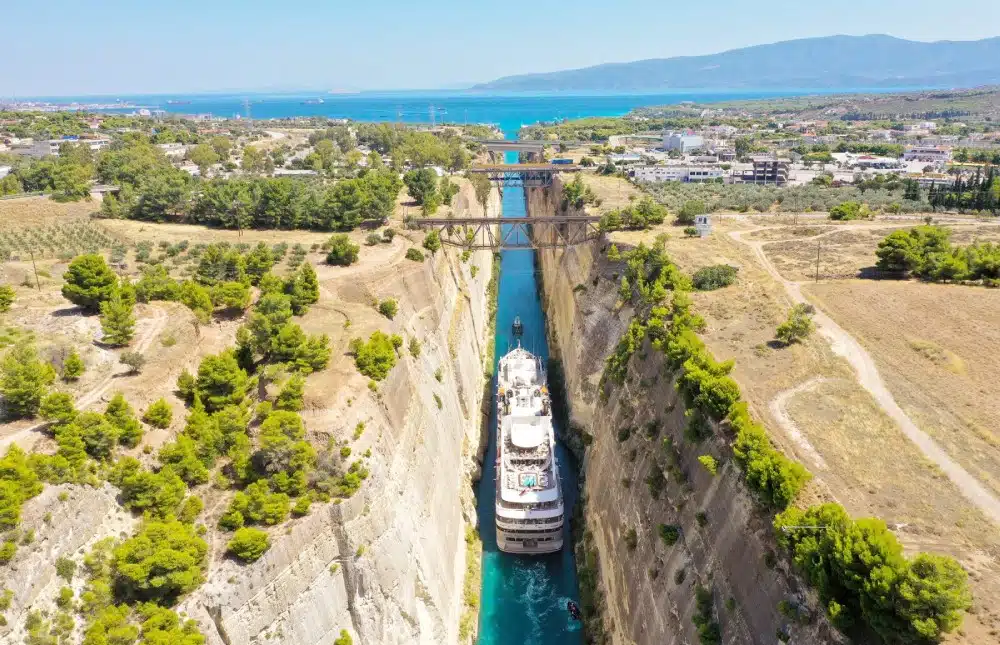
A passage at the heart of Greek history
An engineering pearl with the appearance of millennia-old gorges, the Corinth Canal links the Gulf of Corinth and the Ionian Sea (to the west) to the Saronic Gulf and the Aegean Sea and the Cyclades (to the east), separating the Peloponnese peninsula (to the south) from mainland Greece (to the north). A journey back in time, between turquoise waters and golden cliffs.
An ancient dream
A six-kilometre-long strip of land marking the entrance to the Peloponnese, the Isthmus of Corinth has been a strategic commercial and military passageway for the surrounding cities since ancient times. In the 6th century BC, the tyrant Periander, who ruled Corinth, equipped it with a diolkos, a ramp over which ships wishing to cross from one sea to another were rolled by hand.
For several centuries, this system has made it possible to avoid the long detour around the peninsula. However, it is extremely laborious. In the first century AD, Emperor Nero attempted to replace it with a canal but failed: the cost and technical difficulties were too great for him.
A modern success
The idea resurfaced in the 19th century, once Greece had been liberated from the Ottoman yoke. In 1869, shortly after the completion of the Suez Canal, the Greek government passed a law in favour of a similar project on the Isthmus of Corinth. However, it was not until 1882 that work began… following a plan very similar to that devised under Nero.
Financial difficulties interrupted the excavation in 1889, but it was resumed in 1890, thanks to funds provided by private French and Greek banks, and completed three years later. A French trawler, the Notre Dame du Salut, had the honour of the maiden voyage. Another French boat, the Belem, crossed the canal in 2024, carrying the Olympic flame on its way to Paris.
Spectacular sailing
Today, the Corinth Canal is mainly used for pleasure boating. Crossings are forbidden: boats arriving from the west wait their turn at Posidonia, the others at Isthmia, before being authorised to enter the passage.
The first thing that strikes you is the majesty of the site. Two golden stone walls frame lagoon-coloured water, as if the only purpose of human endeavour had been to reveal a natural beauty that had been buried for too long. With speeds limited to six knots, sailors have plenty of time to admire the surroundings. Everywhere, the marks of history can be seen carved into the rock. Here, traces left by 19th-century workers. There, the remains of Nero’s attempt. Elsewhere, the work of water and wind. The narrowness of the gorge, at most 24 metres, further encourages this intimacy with the past.
The 6.3 kilometre crossing is brief, a pleasure boat being able to navigate the canal in thirty minutes. When the cliffs open up and the exit appears, you have the impression that you have experienced an essential and unforgettable stage of the journey. Perhaps because we felt the heartbeat of eternal Greece.

Photo credits: Studio PONANT-Nicolas Leconte; iStock-Alika Obrazovskaya

Let PONANT take you there
Sail to the most beautiful shores of the Aegean Sea