


 Explore to inspire, a PONANT podcast
 PONANT's cruises
With Petra Glardon, PONANT EXPLORATIONS naturalist guide
A journey to South Georgia is an opportunity to discover a sub-Antarctic island where the grandeur of the landscapes rivals the extraordinary abundance of wildlife. Exposed to some of the most powerful winds on Earth, this remote southern land is home to vast colonies of king penguins, whose sheer numbers can at times blanket entire beaches. Petra Glardon shares her insights into this remarkable world, where wildlife is constantly reshaping the shoreline.
Petra Glardon
For more than twenty years, Petra Glardon has travelled throughout the polar regions, from Antarctic waters to the shores of South Georgia. A biologist specialising in marine mammals and a naturalist guide with PONANT EXPLORATIONS, she accompanies expeditions dedicated to observing colonies of king penguins, Antarctic fur seals and the whales and dolphins of the Southern Ocean. These voyages allow her to observe, season after season, the great cycles of life that shape the wildlife of the Southern Ocean.
Why does South Georgia hold such a special place in the polar world?
South Georgia is very different from Antarctica. It certainly shares the dramatic beauty of polar landscapes, with snow-capped peaks and glaciers that tumble down to the sea. But as part of the sub-Antarctic island arc, north of the White Continent, it lies beyond the reach of the vast expanses of sea ice. Visitors encounter glacial valleys and, perhaps more surprisingly, pockets of vegetation flourishing at these southern latitudes.

What always strikes me is the contrast between the apparent harshness of the place — a remote sub-Antarctic island set amid one of the most inhospitable oceans on Earth — and its extraordinary abundance of wildlife, almost overwhelming in scale. There are also the island’s remarkably vivid colours: the white of the glaciers, the green of certain valleys, the deep blue of the water, and the dark beaches teeming with animals. Throughout the experience, there is a constant sense of entering a realm that does not belong to us.
An Island at the end of the world
Located nearly 1,500 kilometres from the Falkland Islands, South Georgia can only be reached after several days at sea without a port call. Yet along its modest 170-kilometre length, the island boasts eleven peaks rising above 2,000 metres, vast coastal glaciers, and some of the largest wildlife colonies in the Southern Ocean. A tiny speck in the vastness of the Southern Ocean, but one whose isolation and extraordinary abundance of wildlife leave a lasting impression on all who visit.
What wildlife can be observed in South Georgia?
South Georgia is home to around 95% of the world’s Antarctic fur seals, about half of the world’s southern elephant seals, and vast colonies of king penguins.
In the kingdom of the king penguins
The second-largest penguin species after the emperor penguin, the king penguin can grow to nearly one metre in height and weigh up to 15 kilograms. In South Georgia, its colonies are among the largest in the world, numbering more than 75,000 pairs at Salisbury Plain during the peak season, and even more at St Andrews Bay. Remarkably, these colonies remain occupied throughout the year, as the king penguin’s breeding cycle lasts for more than a year.
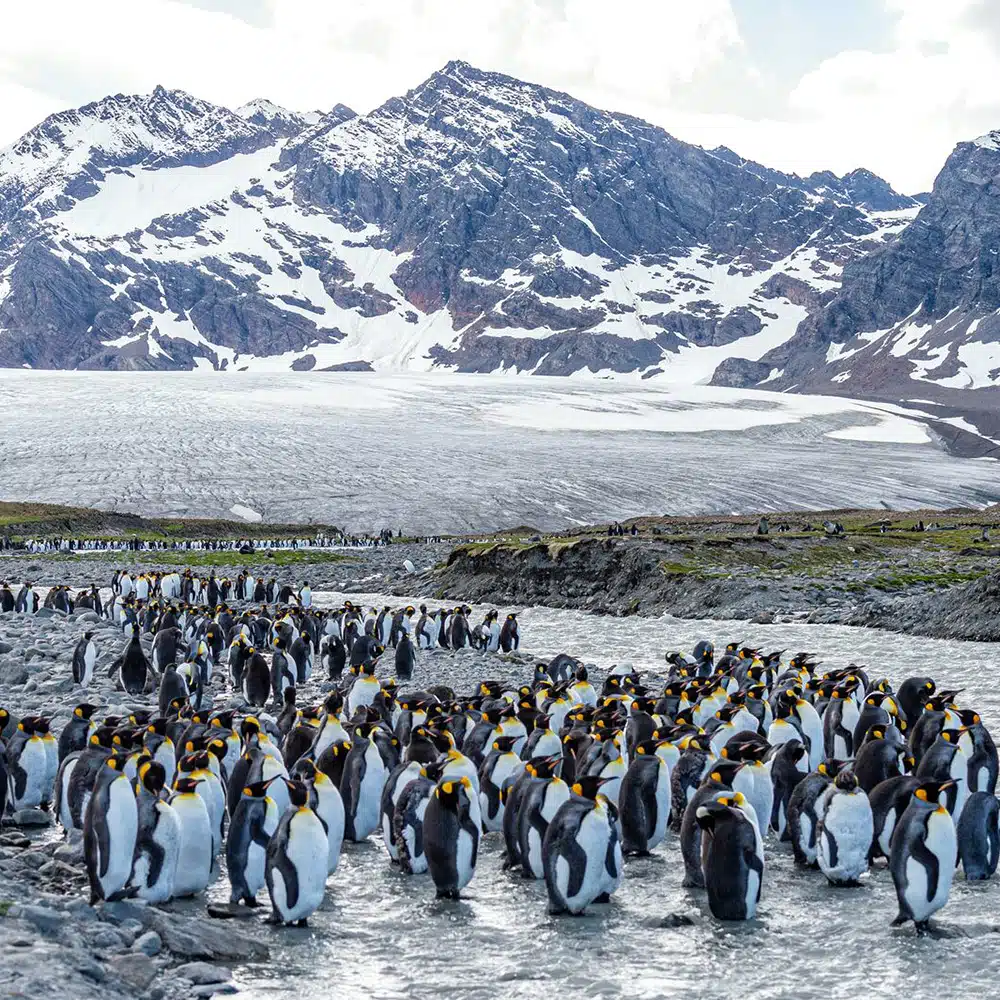
King penguins
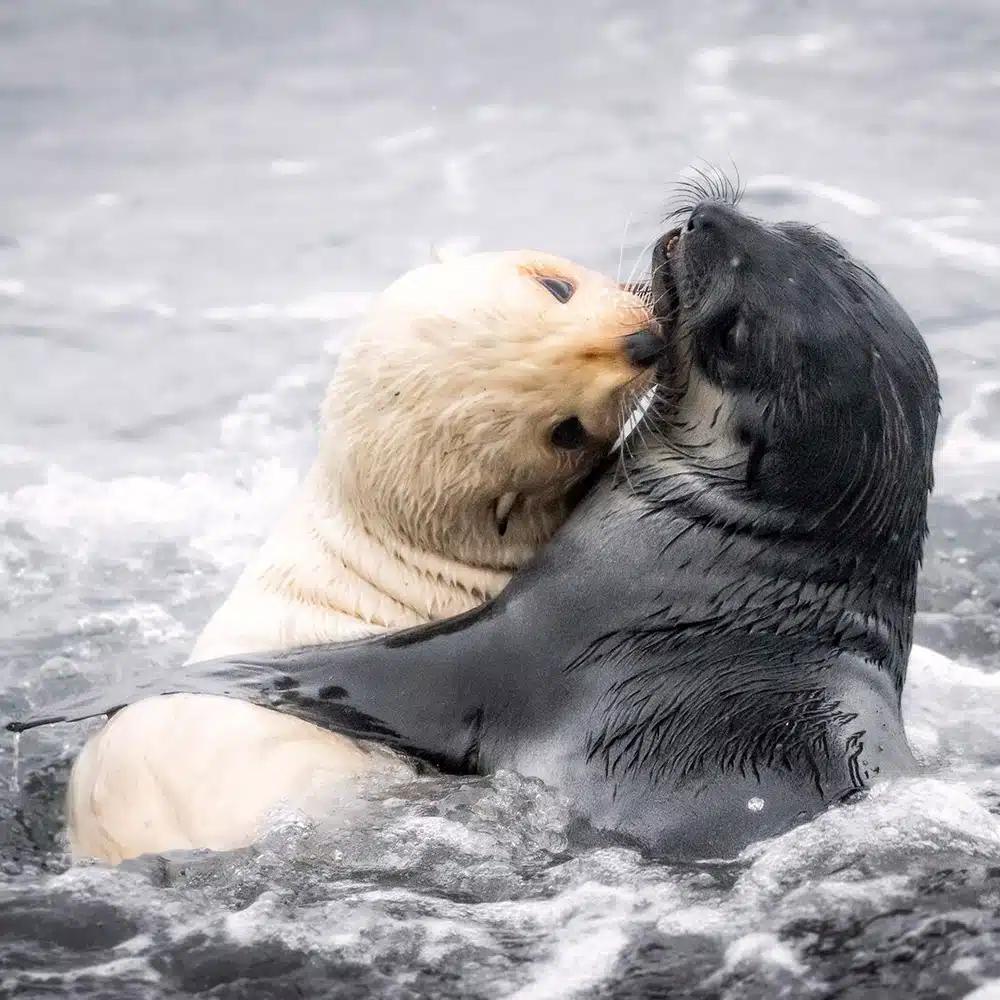
Fur seals

Elephant Seal

Arctic tern
Does the wildlife change significantly over the course of the austral summer?
King penguins remain present on the beaches of South Georgia throughout the year, but their colonies are constantly changing as the season progresses. In December, the large brown chicks, still covered in their thick down, dominate the colonies; a few weeks later, eggs begin to appear, followed by newly hatched chicks. Each stage of the season brings different behaviours, sounds and movements within the colonies, creating an ever-changing spectacle of life.
The beaches, too, follow their own rhythm. At the start of the austral summer, male Antarctic fur seals are the first to arrive, staking out and defending their territories. They are soon joined by the females, and the season’s births begin, before the young gradually take over the shoreline. Sharing this environment are southern elephant seals, albatrosses and a wealth of other seabirds, many of which can also be observed while at sea. In South Georgia, wildlife quite literally reshapes the landscape from week to week.

The colonies are often heard before they are seen. Depending on the wind direction, their sounds may already reach the ship, like a distant murmur carried across the water.
Petra Glardon, PONANT EXPLORATIONS naturalist guide
What does it feel like when approaching the colonies?
The colonies are often heard before they are seen. Depending on the wind direction, their sounds may already reach the ship, like a distant murmur carried across the water. Then, as you draw closer in a Zodiac boat, this wall of sound becomes increasingly intense before gradually breaking apart into its individual elements: the calls of the penguins, the sharper cries of the chicks, and the Antarctic fur seals answering one another from one end of the beach to the other.
By the end of the season, when the young fur seals gather along the beaches, the noise level becomes almost unbelievable, with constant calls echoing continuously across the colony. When a female returns from the water and finds her pup again, identifying it first by its voice then by the smell, among thousands of animals, it is always a deeply moving experience.
I have been returning to the polar regions for more than twenty years, yet the emotion remains exactly the same.
Petra Glardon, PONANT EXPLORATIONS naturalist guide
This experience remains just as powerful after all these years?
Absolutely. I have been travelling to the polar regions for more than twenty years, and the joy never fades. Being surrounded by thousands of animals, in such raw and untamed nature, always stirs something profoundly powerful.
Many guests are deeply moved by what they discover, sometimes to the point of tears. I believe this also stems from a feeling that has become increasingly rare: the sense of entering a territory where human beings are only passing through. Even when conditions become challenging, with wind, cold or rain, every opportunity to go ashore is worth seizing. In these regions, unpredictability is an integral part of the experience.

Fur seals
Does unpredictability play a role in the journey?
In these regions, expeditions always follow an itinerary, with planned landings and sites one hopes to reach, but conditions can change very quickly. The weather can shift within a matter of hours, and the animals, of course, follow no script.
This is also what makes these journeys so unique. Each day remains open to the possibility of an unexpected encounter. One may have studied an animal’s behaviour for years without ever witnessing it, only to suddenly observe it in the field. This element of uncertainty is an integral part of the polar experience.
Does nature still surprise you after all these years?
Constantly! I have, for example, been fortunate enough to witness the birth of an Antarctic fur seal on a beach in South Georgia. The female was in labour while, all around her, birds were already beginning to gather. It is amazing to observe how nature seems to anticipate what is about to unfold.
The Southern Ocean is also the realm of cetaceans…
Yes, although nothing is ever guaranteed in these regions. Humpback whales can be observed, and sometimes orcas as well; in fact, orcas are the animals that fascinate me most. Some populations feed exclusively on fish, while others specialise in hunting seals, even creating waves to dislodge their prey from ice floes.
What continues to amaze me is just how different these groups can be from one another. They have distinct vocalisations, behaviours and hunting techniques specific to each “ecotype”, even though they may share the same waters. In such a vast and untamed environment, observing them offers a rare insight into animals that remain both complex and still only partly understood.

Humpback whale
From whaling grounds to a nature sanctuary
At the beginning of the 20th century, South Georgia became one of the main whaling centres in the Southern Ocean. Stations such as Grytviken welcomed whalers and processing industries, leading to a dramatic collapse in populations of cetaceans. Over recent decades, the archipelago has been the focus of major conservation programmes. In particular, the eradication of rats introduced by ships has enabled the return of numerous seabird species. Today, South Georgia is regarded as one of the great sanctuaries of sub-Antarctic biodiversity, with strict regulations in place to protect its ecosystems.
What difference do naturalist guides make during an expedition?
Our role is to reveal what might otherwise go unnoticed at first glance. This is something I really enjoy about the work; a single detail or explained behaviour can completely transform the way a scene is perceived.
Is it easy to get close to the animals?
What is particularly striking in South Georgia is that the animals do not necessarily perceive humans as a threat. King penguins, in particular, are extremely curious and may sometimes approach visitors on their own. This is precisely why we must remain highly attentive to the distance we keep.
All observation is based on respectful viewing, without disturbing animal behaviour. This is also what makes the experience so powerful: the sense of entering a profoundly wild environment, in which we are simply observers.

PONANT takes you there
Explore the wildlife of the sub-Antarctic islands