

 Explore to inspire, a PONANT podcast
 PONANT's cruises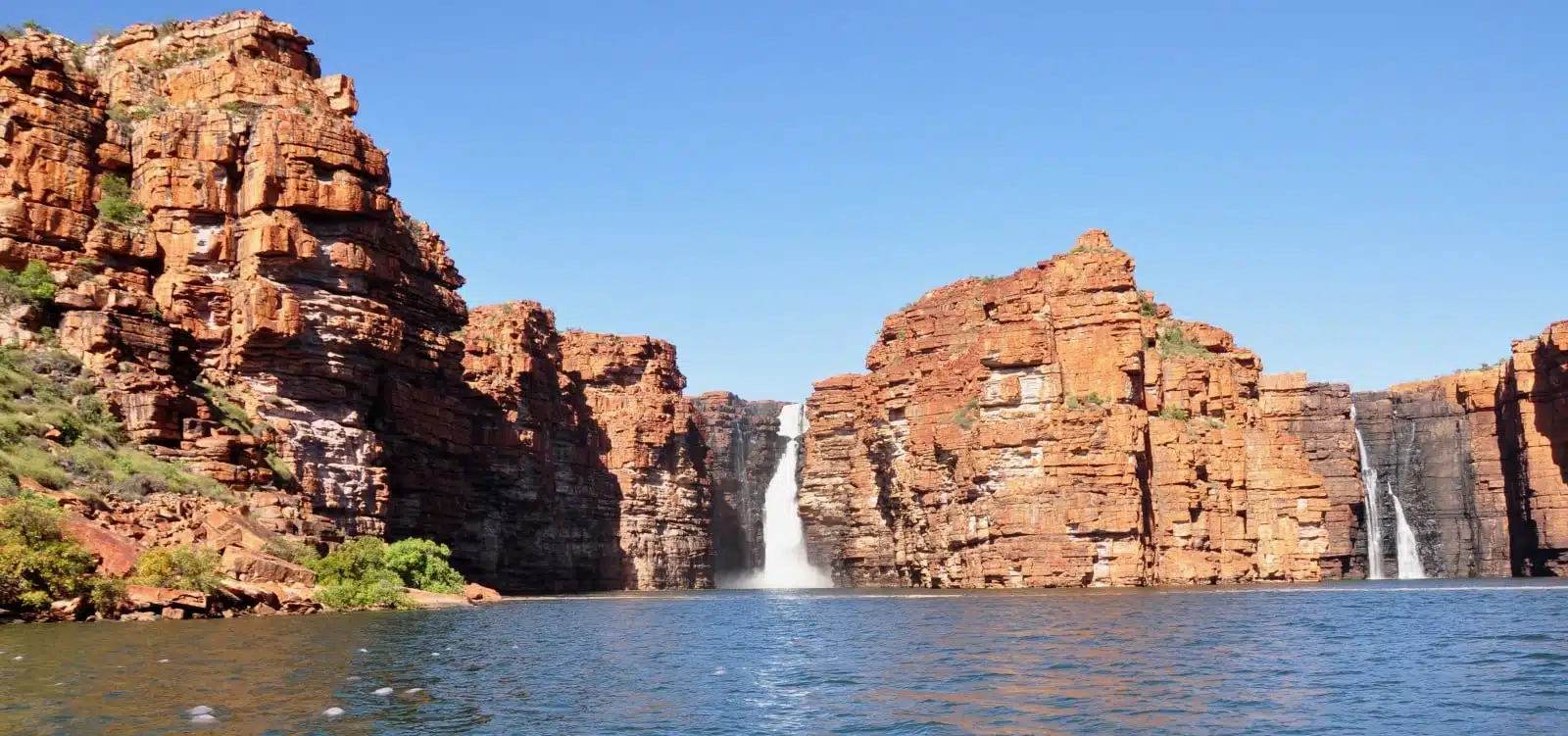
The iconic King George River flow splits into two opposite directions that then forms the massive side-by-side waterfalls that the Kimberley is noted for. (Photo Credit: Photo Credit: ©PONANT / StudioPONANT)
Blog Contributor: Andi Cross, Explorers Club Member & Expeditionist
Come see what I found
“Hey everyone, come see what I found.” It’s the phrase I say most when I’m out on expedition, and this occasion was no different. On the edge of the Kimberley—the great, vast stretch of coastline in the northwest of Australia—what we’d inevitably find was the least exciting thing to consider. It’s what we’d learn from our discoveries that had me more captivated.
Three naturalists gathered around, red dirt swirling around their feet as they made their way over. Stand a little too close out here and you can feel each other’s sweat. But it didn’t matter now, not in a moment like this. An artifact was in hand, and we were all eager to place it. Each one of us held up the little piece of what seemed to be quartz between our index fingers and thumbs, lifting it toward the sun as if we’d somehow be able to tell all of its secrets.

The iconic weather-worn sandstone cliffs of Swift Bay loom large in the Kimberleys. (Photo Credit: ©PONANT / Edges of the Earth – Kimberley by Adam Moore).
We were navigating on foot through Swift Bay, known for its remarkable rock art galleries and ancient connections to First Nations peoples. It’s a place reached by expedition vessels, helicopters, or the occasional sailing yacht, but otherwise, it’s hard to venture to these parts. It’s a landscape so remote that it feels almost untouched by modern civilization.
It wasn’t uncommon out here to stumble across relics from another era. We were already walking across shell middens, layer upon layer of discarded shells left behind by generations who once called this place home. The question now was whether this piece of quartz had also been shaped by human hands, or whether it was simply a beautiful rock that had caught my eye.

A translucent flattened rock almost shaped like a tool and suspected to be a “quartz flake” was a small but effective conversation starter amongst the explorers. (Photo Credit: ©PONANT / Edges of the Earth – Kimberley by Adam Moore)
The indents and carvings in the quartz led half the naturalists to believe it might be what’s called a “quartz flake,” shaped into a sharp tool for hunting or gathering by past Aboriginal people who lived here. The other half thought I’d simply found a lucky rock. Either way, I was pleased with the discovery for even the dialogue it sparked. Surrounded by billion-year-old sandstone and ancient seas, even the possibility that it carried a story felt exciting. The rock art around us was already a sign of lives lived here long before our own. I felt in my element being among it all.
The Kimberley Rewards Curiosity
As we continued through winding and towering rock landscapes painted in deep reds, burnt oranges, ochres and black, I found it hard to look up. I couldn’t help but wonder what else was waiting to be discovered beneath my feet. This place, seemingly so empty as there were few birds flying overhead or any indication of life around us, was anything but.
That’s what the Kimberley asks of you. Unlike East or South Africa or Antarctica, where wildlife often reveals itself in spectacular fashion, this landscape rewards those willing to slow down and look closer. To hone in on your every sense. Catching even the faintest observation. We heard a scratch in the bush, followed by a sudden splash. Our trekking team edged closer to a mangrove tucked against the sandstone, the water impossibly clear and turquoise. My first thought was crocodile, and it turns out I was right.

A crocodile pokes its head out of the murky mangroves to enjoy a bit of sunshine. (Photo Credit: ©PONANT / Edges of the Earth – Kimberley by Adam Moore)
Then there was the rustle of spinifex all around us. Could it have been a Black grass wren? Unlikely. Even the naturalists who return to these trails season after season rarely catch sight of one. Every sound matters out here. Every detail deserves your attention.
We stopped beneath beautiful sloping caves, taking our time with each one as art adorned the ceilings in dramatic fashion. People from another time left their trail, with each painting offering glimpses into life as they knew it. Spirits, animals, people, and stories remained, left for us to interpret today. Even a burial site lay nearby, with a skull protruding from the red rock if you looked closely enough.

A cliffside landscape characterized by the rugged combination of clay, dirt, rocks, slate and harsh vegetation overlooks a smooth, glistening ocean. (Photo Credit: ©PONANT / Edges of the Earth – Kimberley by Adam Moore)
As we moved through this unmistakable wilderness, my eyes stayed fixed firmly on each step in front of me. What did these middens tell us? What was daily life like out here, thousands of years ago? Every step seemed to raise another question.
That’s when I found them. Something more riveting than artifacts from lost and forgotten civilizations: sand dollars. Brown and white, scattered among the rocks. One was as large as my hand, with two others perfectly intact beside it. They stood out like little treasures against the red earth.

Kimberley’s sand dollars of unusual size – some as big as a human palm – are a rare find. (Photo Credit: ©PONANT / Edges of the Earth – Kimberley by Adam Moore)
What did they tell us about where we were? For one, they certainly weren’t recent. We were far too inland for that. Finding them amongst the middens hinted that they, too, belonged to a much older story. Dating them then and there would have been impossible. But imagine how they came to rest in this place? That part came easily. The Kimberley is a place where every discovery, no matter how small, has a way of opening the door to something much bigger.
Where Wild Places Lead Us
Each day, as we embarked on another expedition—whether cruising slowly through winding river systems, peering deep into tangled mangroves, or searching for the saltwater crocodiles that give this region its reputation—the goal was always the same: look closer to think bigger.
Back on board the Le Jacques Cartier, that curiosity didn’t disappear when we left the shore. Some of my favorite moments came from sharing what we’d seen with fellow travelers. Whether through talks or the conversations that continued long afterward. My role was partly to bring my own perspective from years spent exploring the edges of the planet, but just as often, I found myself learning from the people around me. That exchange is part of what makes expedition travel so powerful, so worthwhile. The discoveries continue long after you’ve stepped back onto the ship.

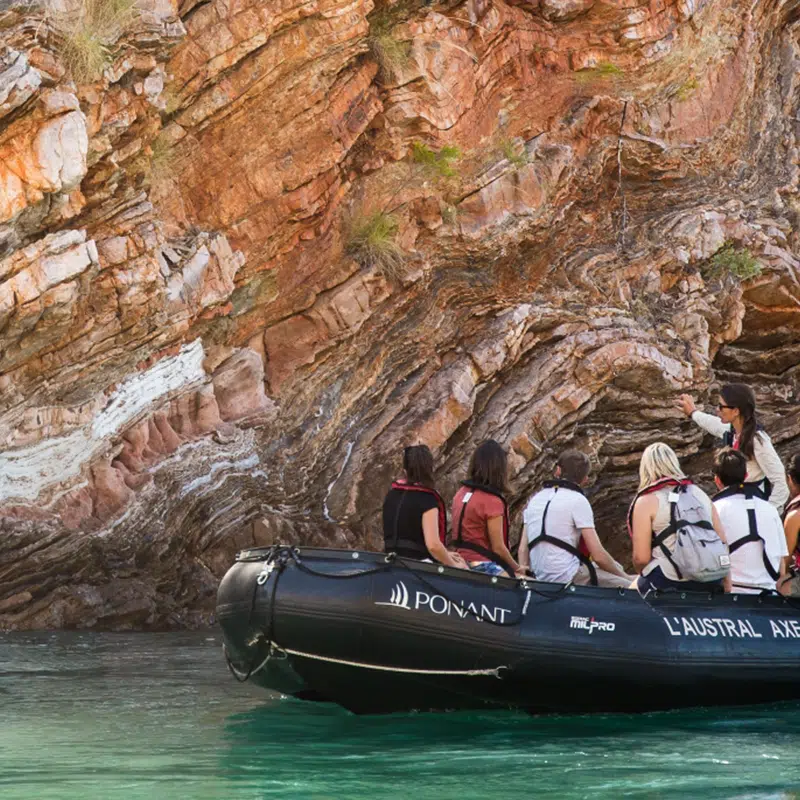
A PONANT EXPLORATIONS ship is anchored at sea while guests explore and venture inland by Zodiac for a more immersive encounter with all the natural and man-made treasures the Kimberleys offer. (Photo Credit: ©PONANT / Edges of the Earth – Kimberley by Adam Moore)
What happens after a ten-day voyage like this? Do we simply return home and slip back into everyday life? Or do we carry a little of the Kimberley with us? Do we begin noticing more, asking deeper questions, and appreciating the wild places that exist much closer to home? Maybe we become a little more curious. Maybe we find ourselves wanting to protect the things we’ve only just begun to understand. And maybe we invite others into that experience too, saying, “Come see what I found,” just as often as we can.
While many people choose a beach holiday or a resort with round-the-clock cocktails, those drawn to expedition travel are often searching for something different. We travel to challenge ourselves, to better understand the extraordinary places that still exist beyond our everyday lives. In doing so, we often discover the unexpected.

Birds peruse the Kimberley landscape from up above. (Photo Credit: ©PONANT / Edges of the Earth – Kimberley by Adam Moore)
Looking back, I don’t think that little piece of quartz was ever the real discovery. Nor were the sand dollars, the rock art, or even the crocodile hidden amongst the mangroves. They were signals that the world still rewards curiosity, and that the most meaningful discoveries often come from slowing down long enough to notice what’s already there.
About the Author
Andi Cross is an international impact strategist, field expedition lead, professional diver, writer and member of The Explorers Club. Through her Edges of Earth project, she and her research team document conservation and climate solutions around the world. In July 2026, she joined PONANT EXPLORATIONS on the Australia’s Iconic Kimberley voyage aboard Le Jacques Cartier, thanks to the onboard speaker series program through PONANT EXPLORATIONS’ alliance with The Explorers Club. Aboard select voyages, Explorers Club Speakers share their expertise, experiences and perspectives with guests throughout the journey.
Explore the Kimberleys
Embark on an unforgettable expedition to the heart of the Kimberley, one of Australia’s wildest and most pristine regions.