

 Explore to inspire, a PONANT podcast
 PONANT's cruises
The call of the wilderness
There are lands where walking becomes a way of stepping into the landscape. Iceland and the Faroe Islands are part of those rare places. On one side, the island has been shaped by fire and ice. On the other, the archipelago is suspended between sky and ocean, where cliffs seem to be rising out of the mist. Anne-Claire Lefèvre Yver, naturalist, local tour guide, and PONANT EXPLORATIONS assistant expedition leader, shares her hiking tips with us.
Iceland, feel the living pulse of nature

You’ll see that each trail tells a geological story that is still being written as you visit Iceland. Here, the earth smokes, sometimes rumbles, cracks, is covered by mosses or freezes. Hiking in Iceland, a land of singular intensity: hiking through the heart of life.
Volcanic relief gives way to black plains, waterfalls are tucked away in a gorge, hot springs draw halos of steam in the cool air, while puffins and Arctic terns fly over the peaks. Each step provides a different scale. Sometimes immense, sometimes intimate, nature in Iceland is never limited to a single view, to a single image.
Landmannalaugar, a symphony of minerals
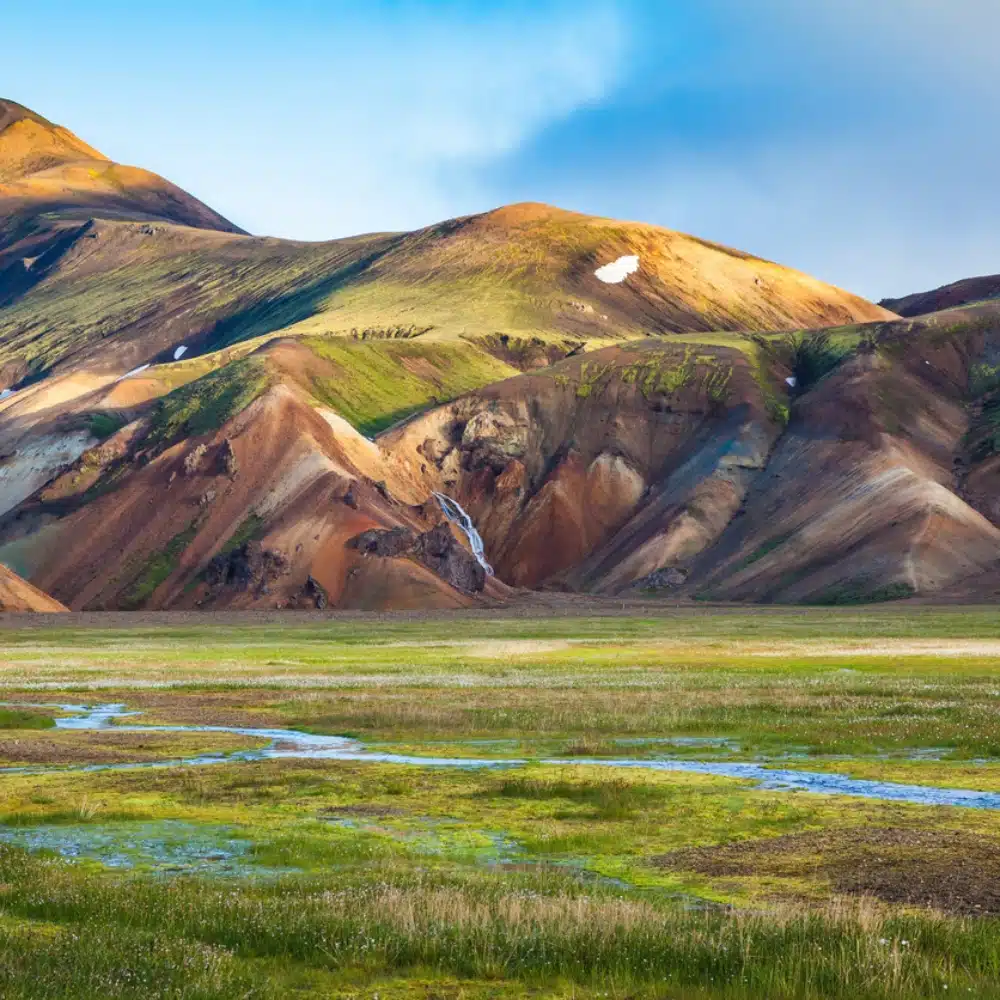
Landmannalaugar is one of Iceland’s top trekking destinations. This region, which is accessible in summer, is famous for its rhyolite mountains and their range of unexpected shades of ochre, pink, soft green and sulphur yellow.
Hiking here is like walking through an open-air painter’s palette. Lava fields rub shoulders with late-lying snow, while hot springs are a reminder of the subterranean force that drives this land. The silence, broken only by the whisper of the elements, further enhances the beauty of the place.
Hiking in Iceland and the Faroe Islands: two worlds
Hiking in Iceland provides a huge variety of grades, often accessible (particularly in the Golden Circle), but sometimes demanding in the Highlands, requiring good physical condition. Along the way, volcanoes, lava fields, valleys and glaciers, and changing weather conditions all add to the adventure. Hiking boots and waterproof clothing are recommended.
In the Faroe Islands, the hiking trails, ranging from 6 to 14 km, are steeper. Trails, which offer different difficulty and altitude grade, run along cliffs and steep slopes, with spectacular panoramic views over the ocean, in a lush, green landscape full of life. High ankle walking shoes and poles are essential for safe hiking.
The glaciers of Vatnajökull, an experience of immensity

Another face of the landscapes of Iceland is that of monumental ice. Vatnajökull is one of Europe’s largest glaciers, a world of whiteness, bluish crevasses and rivers fed by snowmelt. To the east of the glacier, lush green plains are home to herds of wild reindeer, a privileged witness to this extraordinary natural environment.
Walking there has an almost contemplative feel. You can experience the slowness of natural transformations, the power of long-term changes, and the fragility of those balances. Here, nature is less impressive for its immediate, breathtaking beauty than for the sense of infinity it inspires.
The Faroe Islands, raw, vertical nature

A trip to the Faroe Islands offers a striking contrast. Whereas Iceland opens up vast horizons, the archipelago closes the lines. Mountains plunge into the sea, valleys close in on villages with grassy roofs, roads seem to disappear in the clouds.
Hiking in the Faroe Islands is all about the constant proximity between the elements. Here, everything seems steeper, more vertical, more instant.
Spectacular trails between cliffs and ocean

Places like Mykines, renowned for its colonies of seabirds, Kalsoy and its flute-shaped hills, and Saksun, nestling at the bottom of a lagoon, show the extent of Faroese beauty.
The paths skirt dizzying cliffs, overlook the Atlantic and cross windswept meadows. Light changes constantly, going from a sunny glow to a milky haze in a matter of minutes. This natural dramatic work makes the Faroe Islands a truly unique destination, particularly for travellers sensitive to the power of the coastline.
An atmosphere out of time

Beyond the panoramic views, the archipelago also touches for its pace. A few scattered houses, tiny harbours, free-ranging sheep, a road that curves around the mountain: everything seems to be an invitation to slow down.
You walk here to contemplate as much as to feel. The Faroe Islands give you that rare feeling of reaching the edge of the world, in a land where nature still dictates the pace.
Iceland and the Faroe Islands: two complementary visions

Comparing these two destinations is less about contrasting them than about understanding their dialogue. Visitors are fascinated by Iceland‘s ever-changing landscapes: volcanoes, glaciers, lava fields and warm waters. The Faroe Islands captivate with their erosion-sculpted relief, sheer cliffs and a constant link with the ocean.
One evokes the idea of immensity. The others boast a more intimate intensity. Together, they make up an exceptionally rich Nordic journey.
Preparing for your trip: when is the best time to go and what to expect
When it comes to hiking in Iceland and the Faroe Islands, the summer months are the best. From June to September, the long days make it easier to explore and many trails are accessible, particularly in the Icelandic Highlands. However, you will still be at the mercy of ever-changing weather conditions. Wind, drizzle, sudden bright spells: these areas love to surprise. You need to accept some unpredictability, which also contributes to their charm. In the Far North, beauty often comes from a moving sky.
Explore these lands in a whole new light

Discovering these horizons from the sea allows you to grasp their full scale. On a PONANT EXPLORATIONS cruise in Iceland getting close to the coasts and immerse in their immensity is, in itself, a unique journey. As part of an excursion, a hike in the Vatnshellir cave, which inspired Jules Verne, is a truly memorable experience. Similarly, a walk close to Kirkjufell, in the tundra, is in itself an opportunity to reconnect with yourself in an exceptional setting.
From the sea, the Faroe Islands offer a unique spectacular view: the cliffs approach, majestic, under impatient gazes. A PONANT EXPLORATIONS cruise in the Faroe Islands allows you to sail into inaccessible areas, before discovering the magnificent Hvannhagi valley, the village of Saksun and the national museum revealing the life of 20th-century Faroese farmers. The 600-metre-high cliffs of Vestmanna are an unforgettable sight, while the mountain lakes near Torshavn are a patchwork of colours.
Through the eyes of
Anne-Claire Lefèvre Yver
1. Landmannalaugar and Vatnajökull often leave a lasting impression. What’s the one moment you’ll never forget?
The moment I will never forget is when the clouds suddenly dissipate, revealing the panorama. I walked so many times in the fog or under thick cloud cover, wondering if the view would ever reveal itself… Then, unexpectedly, the veil lifts and everything comes into view: the colourful mountains of Landmannalaugar or the icy immensity of Vatnajökull. This contrast makes the beauty all the more striking. These lands teach us patience, acceptance and to let go.
2. What touches you most about accompanying travellers?
What moves me most is seeing travellers discover these landscapes for the first time. Witnessing their first crater, their first aurora borealis, the blow of a whale or the discovery of a glacial lagoon is always a precious moment. I experience their wonder by proxy. I’ve also noticed how much these areas regenerate: some people tell me that they regain energy, balance and vitality when in contact with this powerful and essential nature.
3. Hiking in Iceland is often described as a sensory experience. What memories come to mind?
The first thing that comes to mind when I think of all of those sounds is the humming of the waterfalls, which you can hear even before you see them, as at Dettifoss. Then the wind, capable of making the walker stagger, the waves hitting the coast, the total silence of the snow-covered plateaux. I also think about the colours: the almost fluorescent green moss, the changing light, the black beaches, the milky glaciers.
But one memory dominates: that of a solitary flower spotted in the Fjallabak park, a saxifraga cotyledon growing in the middle of a mineral desert. The next day, as I was walking through a fearsome storm, I thought again about this hardy plant. If it held out, I could move forward too.
4. What Icelandic landscape still moves you today?
Without the slightest hesitation, that would be Heimaey, marked by the eruption of 1973. Within a few hours, the population had to be evacuated, while others stayed behind to protect the town from the lava flows. Five months later, the island was transformed, but still standing.
For me, Heimaey sums up the Icelandic soul: the sometimes brutal power of the elements and the collective strength of those who live in contact with them. Every stop off is an emotional moment.
5. Does hiking in the Faroe Islands have a different feel?
Yes, it’s a very different feel. The Faroe Islands, which are geologically older, offer lush green landscapes softened by a more humid climate. But their signature is verticality: sheer cliffs, valleys plunging into the ocean, panoramas suspended above the waves.
I am particularly fond of the summit of Slættaratindur, the highest point in the archipelago. The climb is harsh, but the reward is immense: a string of islands, fjords and shifting light, in an almost unreal atmosphere. Even under a threatening sky, I find this place deeply moving.
Photos credits: © iStock ; ©Studio PONANT : Doriane Lete, Avi Bhuruth.

PONANT takes you there
Explore the most beautiful shores of the North Atlantic islands.