

 Explore to inspire, a PONANT podcast
 PONANT's cruises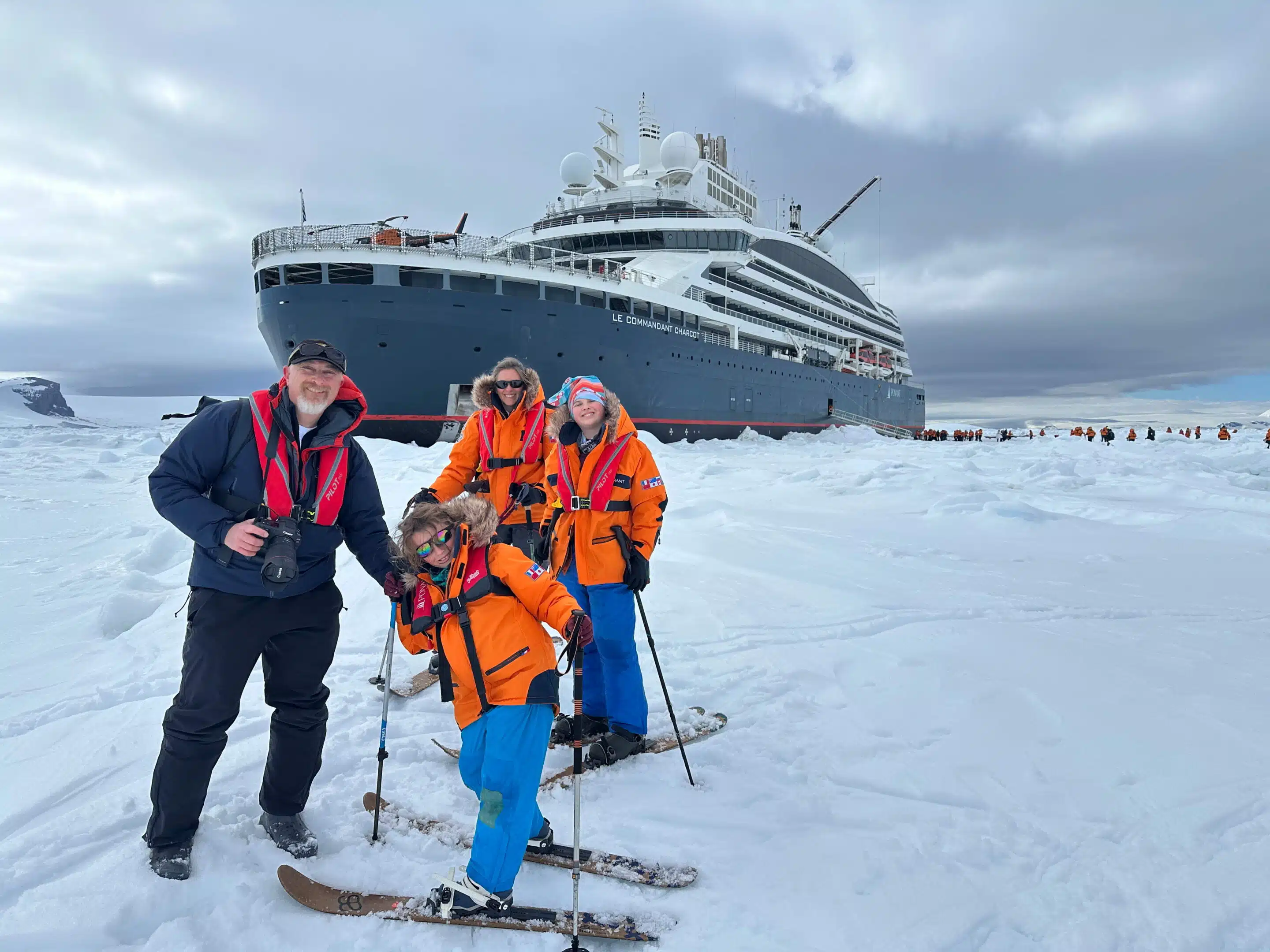
We’re pleased to share a firsthand story from Explorers Club Speaker Dr. Cassandra Brooks, who recounts her family’s expedition through the Weddell Sea aboard Le Commandant Charcot. Joined by her husband and conservation photographer, John Weller, and their two young children, she shares their adventures and insights—from encounters with Adélie penguins to lessons about Antarctica’s fragile ecosystem—her journey is a powerful reminder of why this remarkable region deserves our protection.
“I could watch this all day”.
We are perched at the bow of the Charcot, mesmerized by the vessel’s powerful motion through the thick ice of the Weddell Sea. We rise slightly as the compression from the vessel forces a split in the ice. The crack spreads, widening, and the impossibly thick ice parts, breaking and revealing its deep blue interior and underbelly thick with green algae which forms the basis of the Antarctic food web.
My son Orion Ross (named for the Ross Sea) says, “I could watch this all day”. And he did, day and night, with the golden hues of the Antarctic midnight sun glowed off the expanse of sea ice. My daughter Adelie (named for the penguin) points at the huddles of Adélie penguins. We can see scatterings of crabeater seals in every direction. At the edge of the ice orcas roam, hunting for fish, penguins, and seals and whales gorge on krill. I stand and breathe in the rich smells of one of the most productive ecosystems in the world.
Orion Brooks follows in his parents footsteps as they explore Antarctica as a family. (Photo Credit: Dr. Cassandra Brooks)
Ice in Life
Ask any Antarctic ecologist and they will tell you, “ice is life”. It provides a platform for breeding, feeding, and resting for larger animals like penguins and seals. But as its underside reveals, it also provides nutrients supporting rich algae communities which in turn feed Antarctic krill – the most important prey species in the Antarctic and potentially the most abundant animal on earth. Indeed, massive swarms of Antarctic krill in turn support the large populations of penguins, seals, and whales found in the Southern Ocean.
It’s Christmas Day and we parked the vessel in the ice off the Antarctic Sound. Immediately, the Adélie penguins came to investigate. We walked from the ship, venturing out onto the thick sea ice. The wind was whipping with snow flurries falling. In the distance, hundreds of Adélies were approaching, waddling and sliding elegantly on their bellies. My daughter could not stop smiling, as the extensive stream of Adélies passed her by, with dozens pausing, gazing at her curiously.

Ever curious, waddles of Adélie penguins march in to investigate the visitors while Adélie Brooks and other very happy guests look on. (Photo Credit: Dr. Cassandra Brooks)
Protecting Antarctica
I’ve worked in Antarctica for more than 20 years now, most of that time spent working alongside my husband, conservation photographer John Weller, towards protecting Antarctica. We were part of a global campaign to protect the Ross Sea, Antarctica. John coined the Ross Sea as the Last Ocean to help people understand how this was among the last large healthy marine ecosystems left in the world. The campaign was successful and the Ross Sea was protected as of 2017 and is still among the largest marine protected areas in the world. Next year, we will travel with PONANT to the Ross Sea to celebrate the 10th birthday of the protected area.
While the Ross Sea enjoys protection, most of the waters around Antarctica do not. Aboard Le Commandant Charcot, I gave lectures to guests, sharing stories from previous research expeditions and offering insights from my research on Antarctic fish (and their amazing polar adaptations, including having anti-freeze proteins in their blood). I also explained the threats to the Antarctic environment, including climate change, commercial fishing, and pollution. Amidst these threats, I shared about the ongoing global efforts to expand protections in Antarctica, including efforts for large-scale marine protected areas in the Weddell Sea and Antarctic Peninsula.

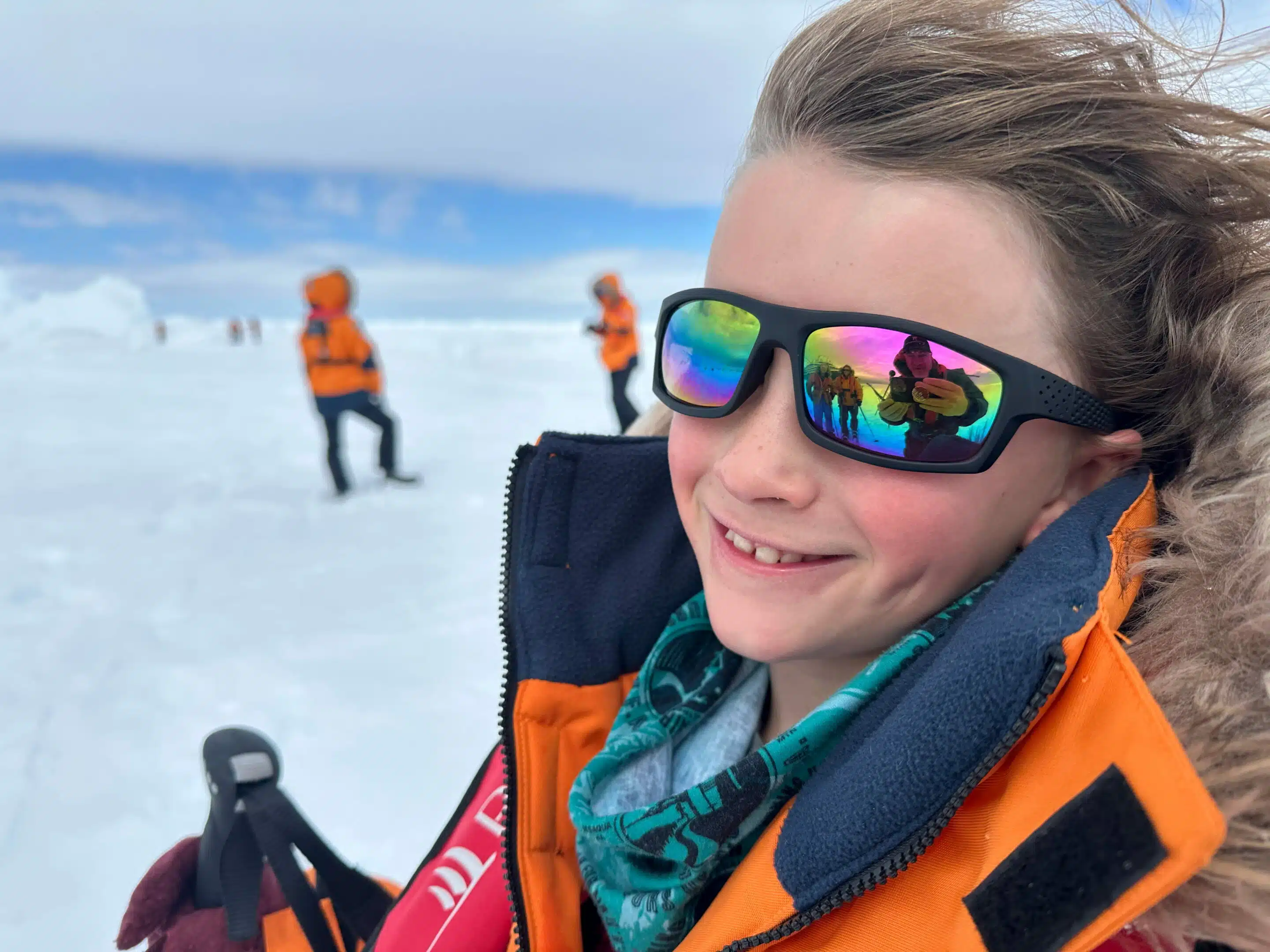
Explorers come in all shapes, sizes… and ages! Adelie and Orion Brooks memorializing the majestic sights of Antarctica with their cameras. (Photo Credit: Dr. Cassandra Brooks)
The Next Generation
I stood on stage before the guests, sharing a story. Before Antarctica had ever been mapped or explored, the ancient Greeks actually insisted that a great southern land must exist in symmetry with the expansive land mass in the north. Without it, they said, the earth would topple over. And the Greeks were right. Because since the discovery of Antarctica scientists have documented how Antarctica stores the majority of the world’s freshwater, drives global ocean circulation and regulates our climate – storing disproportionate amounts of carbon and heat. Indeed, Antarctica keeps the world in balance, and our very survival depends on its ongoing health.
After the lecture, I was approached by a girl on board. She was starting high school next year and wanted to see if there are opportunities to do Antarctica research with my lab group. We exchanged information and I ensured her there would be. She had fallen in love with this place, and she wanted to work to understand Antarctica and to protect it both for the sake of the amazing life that lives there and for the next generation whose survival depends on keeping this great southern land intact.

Travel and exploration sparks a different type of tangible inspiration in every explorer who has seen and experienced the wonders of Antarctica. (Photo Credit: Dr. Cassandra Brooks)
Paulet Island
Our last landing was a visit to Paulet Island – home to a large Adélie colony, supporting ~200,000 penguins. Before going ashore, we stood at the front of the vessel, staring at the large steep island, which appeared covered in dirt. But a glance through my husband’s 600mm lens revealed another story. Every black speck was actually an Adélie penguin! They covered every part of the island, from the flat regions to the steep hillsides. We were awestruck and quickly got dressed to go ashore.
Ashore, we walked carefully among the thousands of penguins, many of which were on nests. They revealed an amazing sight – little gray fluffy baby penguins hiding beneath the safety of their parents. My son hid his face in his jacket to try to avoid the overpowering stench of so many penguins. My daughter clung to her camera, seeking to capture a baby penguin as it peeked out from below its parent. The sound of so many penguins calling and babies chirping was deafening. Skuas flew overhead, a threat to the young penguins. Amidst the colony was also a spattering of gentoo penguins, a small colony of blue-eyed shags, and even a seal lazing about. Just offshore, humpback whales roamed, hunting on krill. The sheer abundance of life in Antarctica is staggering.

Paulet Island is home to one of Antarctica’s largest Adélie penguin colonies, with more than 200,000 penguins gathering each breeding season. (Photo Credit: @StudioPONANT)
Going Home
We left Antarctica full of stories, my children’s lives changed, their worlds expanded in ways I am still seeing play out in their new knowledge and growth as human beings. My son just showed his Antarctic photography at his elementary school art show. He stood next to his favorite photo of an engorged resting gentoo on its nest and told other kids and families about his trip to Antarctica. About the cold, wind, and ice. About how life thrives in mythical abundance.
My kids have grown up hearing about Antarctica but to actually see and experience its extreme environment and array of wildlife was life-changing to say the least. They had never felt so alive and they are taking that sheer joy and excitement out into the world around them. They cannot wait to go back.

About the Author
Dr. Cassandra Brooks is an Associate Professor in Environmental Studies at the University of Colorado Boulder and a Faculty Fellow in the Institute of Arctic and Alpine Research. Cassandra has a fierce passion for Antarctica, with the last 20 years of her career focused on protecting the region.
Her shared account is from the PONANT EXPLORATIONS and The Explorers Club voyage, The Emperor Penguins of Weddell Sea, that she and her family sailed on from December 20, 2025 to January 3, 2026.
Explore with Dr. Brooks in 2027
Inspired by Dr. Cassandra Brooks’ journey? Join her in January 2027 aboard Le Soléal, where she will return as one of our Explorers Club speakers on the Scott & Shackleton’s Antarctic – Ross Sea Expedition voyage.

Explore to Inspire
There is an adventure for every type of explorer aboard PONANT EXPLORATIONS. Find yours today.