

 Explore to inspire, a PONANT podcast
 PONANT's cruises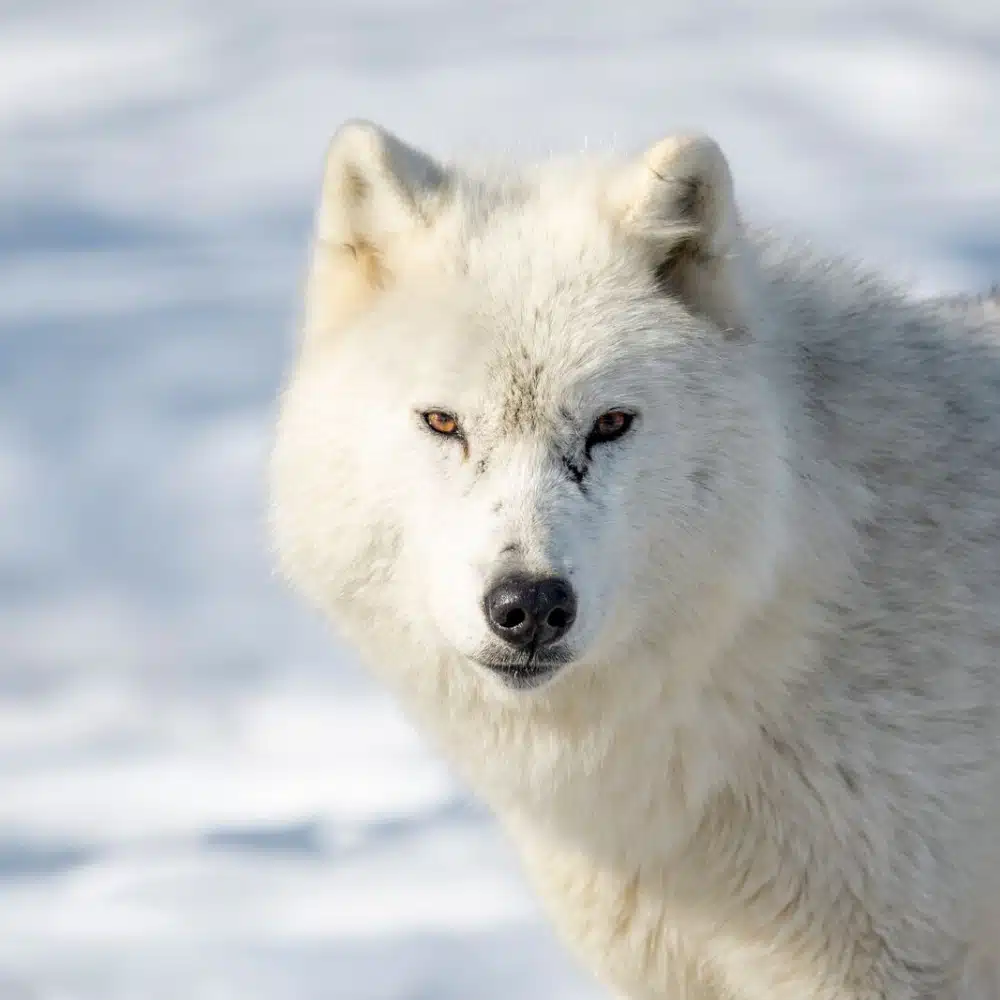
Where The White Begins
Beyond the glaciers and ice cathedrals, past the fjords that swallow the horizon and the waterfalls that thunder into silence, the Arctic holds something equally as captivating: extraordinary wildlife.

A polar bear rests on Arctic sea ice, perfectly adapted to life in one of the planet’s most extreme environments. (Photo Credit: Adam Maire / Ocean Image Bank)
King of the Arctic
At first glance, what looks like a canvas of white gradually reveals a living world that took millions of years to paint. Travelers who have made the journey to the Far North often describe the same experience of scanning the landscape, certain there was nothing to see, when a movement caught their eye. A polar bear. And should you be fortunate enough to encounter more than one, a group of polar bears is called a celebration. Indeed.
As the undisputed apex predator and largest land carnivore on Earth, Ursus maritimus—the sea bear—sits at the very top of the Arctic food chain. With males weighing up to 1,433 pounds (and females coming in at a slim 772 pounds), the polar bear spends most of its life on sea ice, hunting the seals that sustain it through the long winter. Believe it or not, these Arctic icons do not hibernate. Through the coldest months of the polar year, they are out on the ice, active and alert.
In Inuit mythology, Nanook is the supreme guardian spirit of all polar bears, the force that determines whether a hunter has conducted himself with sufficient respect to earn success. The bear’s ability to rise and walk upright further deepened its reverence across the circumpolar north. Legends also tell of bears that shed their fur and walked among the people, teaching them to survive.

Arctic fox pups are born dark and fuzzy, gradually revealing their earthy summer coats within just a few weeks. Their thick white winter coat starts to develop in late autumn. (Photo Credit: @Studio PONANT)
The Land Beyond the Bear
The Arctic fox is among the most elegant survivors on the planet, wearing a rich brown coat in summer, and shifting to a luminous white so complete that a fox sitting motionless on the snow becomes invisible. The Arctic hare performs the same vanishing act with equal conviction.
On the other hand, the muskox looks like an animal that time forgot. Shaggy, broad-shouldered, and draped in qiviut—prized as some of the softest and warmest natural fiber in the world—muskoxen are Ice Age survivors, largely unchanged since woolly mammoths walked beside them. When threatened, they form a defensive ring, adults facing outward with horns lowered, with the young sheltered in the middle. This formation of protection has worked for tens of thousands of years.
Reindeer, or caribou as they are known in North America, cover thousands of miles between seasonal feeding grounds in migrations that rank among the great recurring spectacles of the natural world. Arctic wolves shadow these journeys, reading the herd with an intelligence researchers continue to study.

An orca surfaces in Arctic waters beneath snow-covered mountains. (Photo Credit: Toby Matthews / Ocean Image Bank)
The Whales Beneath the Ice
Three whale species make the Arctic their home year-round. The beluga, brilliantly white and built without a dorsal fin for easy maneuvering beneath the ice, communicates in whistles and chirps so varied that sailors named it the canary of the sea. Meanwhile, the bowhead whale boasts a blubber-reinforced skull capable of breaking through the ice above! Living well past 200 years, the bowhead sings such complex songs that researchers call it the jazz singer of the ocean.
Then there is the narwhal, carrying more mythology than perhaps any other creature of the sea. Medieval Europeans believed its spiral tusk was a unicorn horn, a relic so powerful it sold as a cure for poison. In truth, the tusk is the whale’s upper left canine tooth, growing counter-clockwise for up to eight feet and threaded with millions of nerve endings. Researchers have determined that it functions as a sensory organ, able to detect shifts in water salinity and temperature. When two males touch tusks, they may be exchanging information about the waters each just passed through!
During the brief Arctic summer, the waters here welcome humpbacks, blue whales, orcas, and minkes from thousands of miles away. They come to feed in a sea rich with nutrients, building up their blubber reserves while putting on acrobatic displays and exhaling with spectacular blows.
And Deeper Still…
Below all of them, the Greenland shark moves through the deep cold with prehistoric indifference. The longest-lived vertebrate known to science—its life span is estimated to exceed 400 years—it reaches sexual maturity at roughly 150 years, with pups gestating for eight to 18! In a world that measures everything in news cycles and social clips, the Greenland shark is a reminder of how deep time runs.

Taking a break between dives, a bearded seal rests atop Arctic sea ice. Photo: Giancarlo Gallinoro / Ocean Image Bank. (Photo Credit: Giancarlo Gallinoro / Ocean Image Bank)
The Ice and What Rests Upon It
Sea ice is a habitat as much as it is a landscape. Six species of seals—grey, harbor, ringed, harp, bearded, and hooded—haul out on its surface to rest and raise their pups, while walruses gather in vast and improbable herds. The ice edge, where frozen sea meets open water, is a nutrient-rich “superhighway” of life, drawing a density of wildlife that consistently amazes visitors.

With its colorful beak and unmistakable charm, the Arctic puffin brings a splash of color to the northern seas. (Photo Credit: Ujval Pasupuleti / Ocean Image Bank.)
The Sky Above
The snowy owl surveys all of this from a low tundra perch, hunting by sound, capable of detecting a lemming moving beneath a full foot of snow. The Arctic tern, weighing about as much as a bar of soap, completes a roundtrip between the Arctic and Antarctic—a mere 43,296 miles—logging more miles than any other animal on Earth and enjoying two summers every year.
Into this realm of sincerity, the Atlantic puffin brings a dose of comedy. Its beak erupts into vivid orange and yellow during breeding season, a burst of color so improbable in the grey North Atlantic that it seems like a costume, hence the nickname “clown of the sea” or “sea parrot.” The coloration fades once a mate is secured, because the puffin is nothing if not practical. It returns to the same partner year after year, raises one chick per season, and flies with a frantic wingbeat that makes its sturdy body look perpetually astonished to be airborne.

Exploring the Arctic aboard a PONANT EXPLORATIONS vessel brings travelers closer to the region’s extraordinary wildlife and landscapes. Pictured here: Le Commandant Charcot navigating polar ice. (Photo Credit: @StudioPONANT)
A Living World Worth Knowing
Aboard its fleet of small, state-of-the-art exploration vessels, PONANT EXPLORATIONS brings guests to the Arctic as active, informed witnesses to the marvels of Mother Nature. Through alliances with leading scientific institutions and exploratory organizations, dedicated journeys through the Canadian High Arctic, Greenland, Iceland, Svalbard, and Norway carry researchers, naturalists, and expedition specialists whose work extends well beyond the ship. To travel to these destinations is to see something rare. To explore here with PONANT EXPLORATIONS is to begin to understand it.
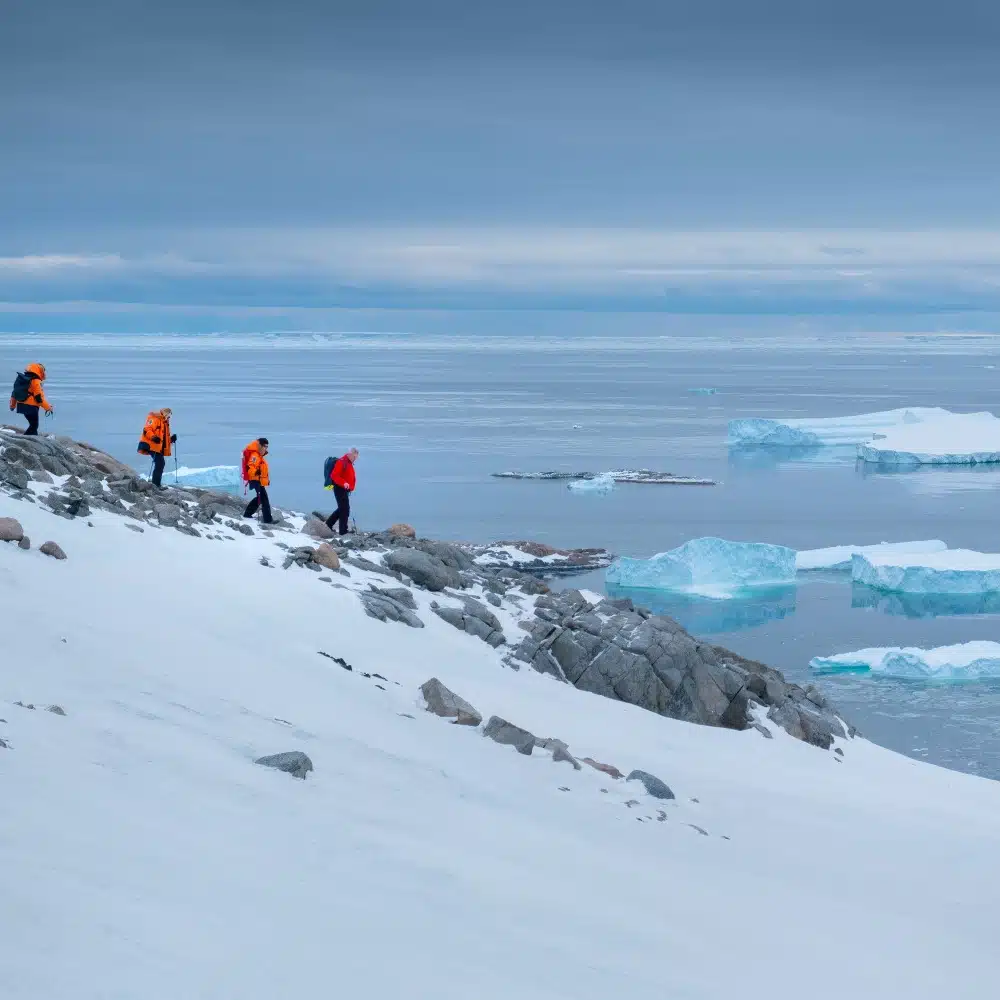
The Arctic and its Wonders Await
Aboard PONANT Explorations, you step back as a mere spectator, immersing in the Arctic’s unapologetically majestic, sovereign wilderness.