

 Explore to inspire, a PONANT podcast
 PONANT's cruises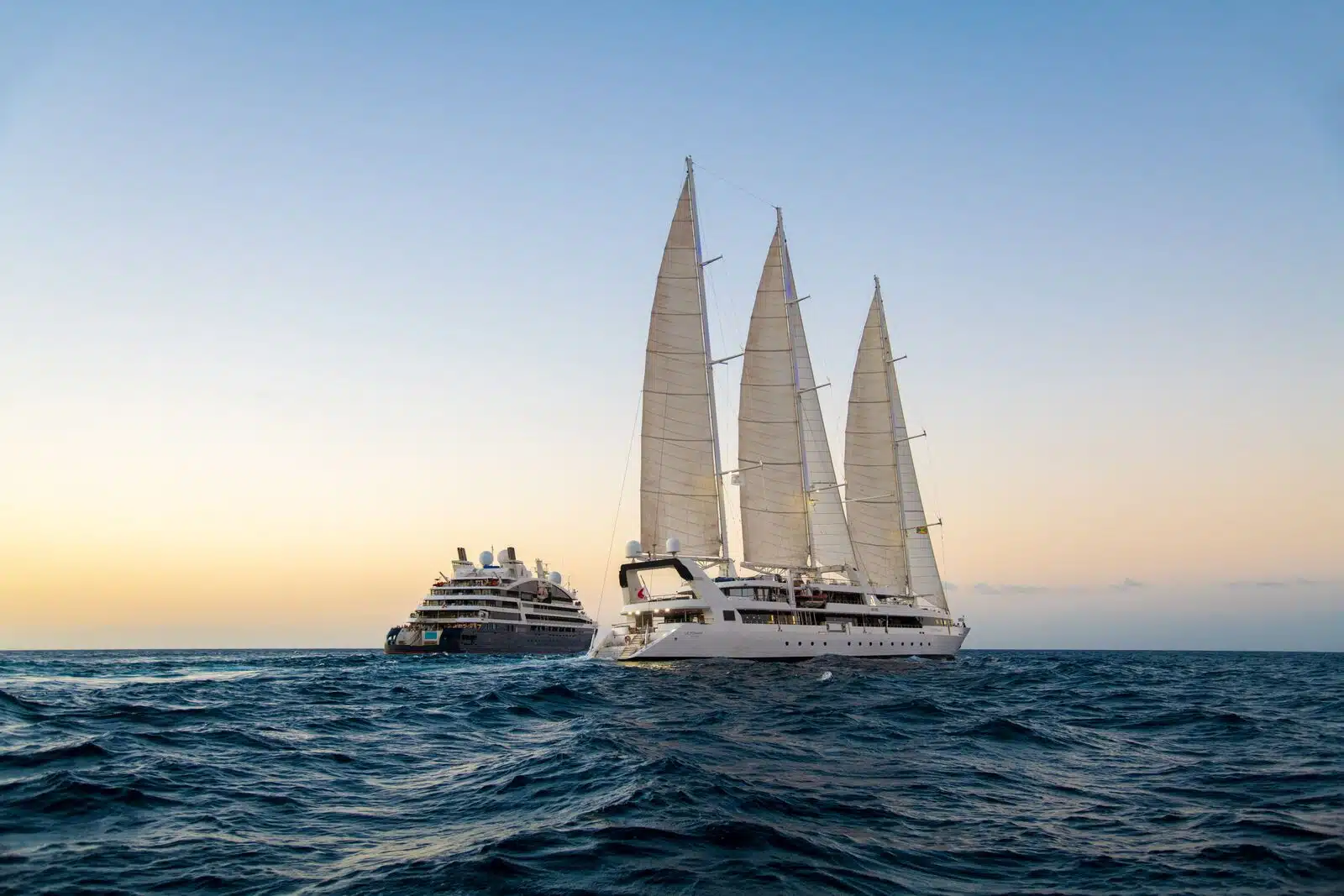
From legendary explorers to winds, light, and latitude, discover the inspiration behind the ship names of PONANT EXPLORATIONS

Le Dumont-d’Urville and Le Champlain navigating the Atlantic, honoring two of France’s most celebrated explorers. (Photo Credit: @Studio PONANT / Margot Sib)
For PONANT EXPLORATIONS, ship names are declarations of a bold pioneering spirit and a deep connection to the natural world. They represent voyages driven by curiosity, wonder, and the enduring human impulse to discover what lies beyond the horizon.
Le Ponant: The Beginning
Ponant is an old French maritime word meaning west. Partner to levant, meaning east, it is steeped in the seafaring tradition that heralds the western wind blowing from the Mediterranean toward the open Atlantic—the direction of departure and possibility. Distinctly French and quietly evocative, it is the name given to this company and its first ship, a three-masted sailing yacht called Le Ponant. intimacy over scale, authenticity over spectacle

Le Ponant, the sailing yacht that marked the beginning of PONANT EXPLORATIONS. (Photo Credit: PONANT / Sophia Steeg)
The Sisterships: French Elegance Meets Exploration
Atmospheric, elemental, and celestial, the fleet’s four sisterships continue the poetic relationship to the natural world. Le Boréal takes her name from Boreas, the ancient Greek god of the north wind, the same root that gives us aurora borealis, while L’Austral looks south with a name rooted in the austral hemisphere, the vast reaches below the equator the fleet regularly explores.

Le Boréal approaching shore, carrying the elegance and adventurous spirit of the Sisterships. (Photo Credit: @Studio PONANT)

Le Champlain and Le Bougainville at sea together, reflecting a shared legacy of curiosity, discovery, and exploration. (Photo Credit: @Studio PONANT / Ophelie Bleunven)
The Explorer Class: A Legacy of France’s Boldest Adventurers
The Explorers are named for six Frenchmen who made exploration and discovery their life’s work. Each sailed toward the unknown with purpose, conviction, and an insatiable desire to know more about the world.
In 1534, Jacques Cartier sailed into the Gulf of St. Lawrence—the first European to map the waterway—and claimed it for France. In doing so, he also inadvertently named Canada. He borrowed the Iroquoian word kanata, meaning ‘village,’ and applied it to the entire region. On his second voyage, he wintered in what is now Québec and learned from the Iroquoian people of a plant remedy for scurvy, saving his crew.

Le Jacques Cartier at sea in the South Pacific. (Photo Credit: @Studio PONANT/Mike Lougie)
Known as the “Father of New France,” Samuel de Champlain is the man who mapped the St. Lawrence River and founded Québec in 1608. What is less commonly known is that Champlain crossed the Atlantic at least 27 times between 1603 and 1633. He was also among the first European explorers to document Indigenous peoples with genuine curiosity, producing detailed accounts of their languages, customs, and ways of navigating the land.

Le Champlain sailing through open waters, embodying the spirit of exploration that defines PONANT EXPLORATIONS. (Photo Credit: ©Studio PONANT/ Margot Sib)
Louis Antoine de Bougainville led the first French circumnavigation of the globe, from 1766 to 1769. Hidden among his crew was Jeanne Baret, a botanist who had disguised herself as a man to join the expedition (women were not allowed on naval ships), making her first woman known to have circumnavigated the globe. In Rio de Janeiro, she helped collect and name a flowering vine that adorns gardens, walls, and homes all across the world to this day: bougainvillea.
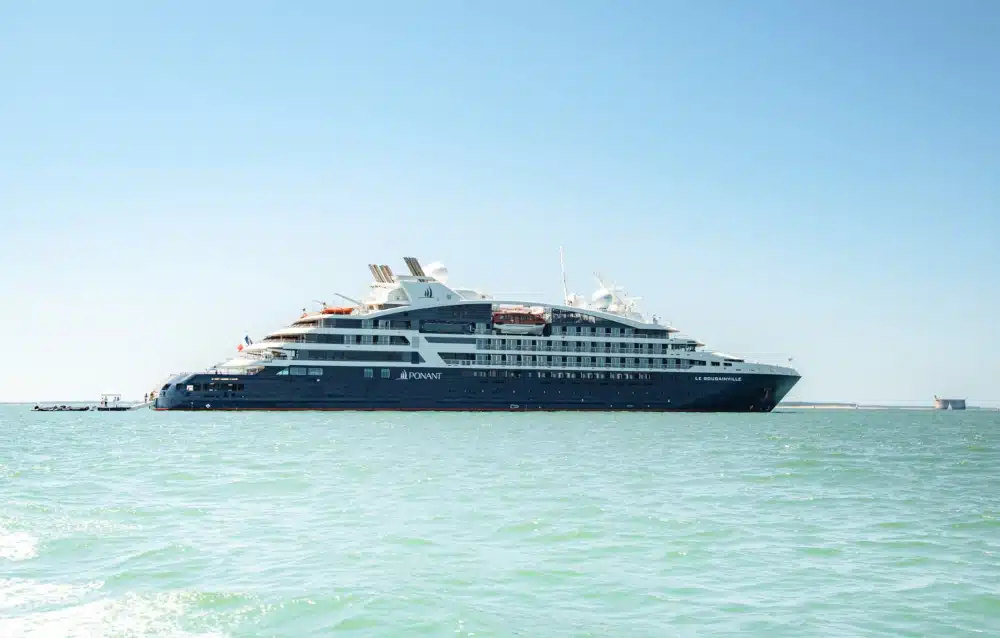
Le Bougainville at sea. (Photo Credit: ©Studio PONANT)
Jean-François de Galaup, count of Lapérouse, set sail from Brest in 1785 on one of the most ambitious scientific expeditions of the age. Commissioned by Louis XVI to complete the discoveries of Captain James Cook, Lapérouse visited Chile, Hawaii, Alaska, Korea, Japan, Samoa, and Australia. And then he vanished. His ships were never heard from again after leaving Botany Bay in 1788. The mystery gripped France so deeply that Louis XVI, on his way to the guillotine in 1793, paused to ask if there was any news of Lapérouse.

Le Lapérouse in the Kimberley region, honoring the enduring spirit of adventure that defined Jean-François de Lapérouse. (Photo Credit: @Studio PONANT)
Jules Dumont d’Urville was quite the Renaissance man: naval officer, botanist, cartographer, and linguist fluent in a dozen languages. A French scientific station in Antarctica now bears his name as does the surrounding sea. He claimed Adélie Land for France in 1840, naming it for his wife. The Adélie penguin takes its name from the very land he discovered, which means every sighting of these tuxedoed seabirds is a small tribute to Madame d’Urville.

Le Dumont D’Urville departs the shores of Norway. (Photo Credit: @Studio PONANT / Fred Michel)
Joseph-René Bellot was 25 when, in 1851, he volunteered to join a British Arctic expedition searching for Sir John Franklin, whose two ships and 128 men had vanished in the Canadian Arctic in 1845. He sailed at his own request, paying his own way. He discovered Bellot Strait in 1852, and died in the Arctic the following year at 27, falling through the ice. The British erected a granite obelisk in his honor at Greenwich, the only Frenchman ever so recognized in England.

Le Bellot sailing the waters of San Blas, Panama. (Photo Credit: @Studio PONANT )
Jean-Baptiste Charcot, the French polar explorer and physician whom his contemporaries called “the gentleman of the poles,” was a man of independent means who could have lived comfortably in Paris. Instead, he funded his own expeditions to the Southern Ocean to collect scientific data for the sake research—no territorial claims, no commercial ambition. He died at sea in 1936, when his beloved ship Pourquoi-Pas? (“Why Not?”) foundered off Iceland in a storm. He was 70 years old and still exploring.

Guests paddle on open kayaks as Le Commandant Charcot stands tall anchored in Antarctica. (Photo Credit: @Studio PONANT)
Every Voyage, A Legacy
Le Ponant sets the direction. The Sisterships orient the fleet to the elements. The Explorer class honors those who went first. And Le Commandant Charcot carries the vision of its founders to the furthest reach.
Board any one of these ships, and you are sailing in distinguished company.

Explore the World with PONANT EXPLORATIONS
Whether you’re drawn to remote coastlines, cultural treasures, or expedition voyages, PONANT’s fleet of purpose-built ships lets you discover the world your way—in comfort, style, and unmatched authenticity.