

 Explore to inspire, a PONANT podcast
 PONANT's cruises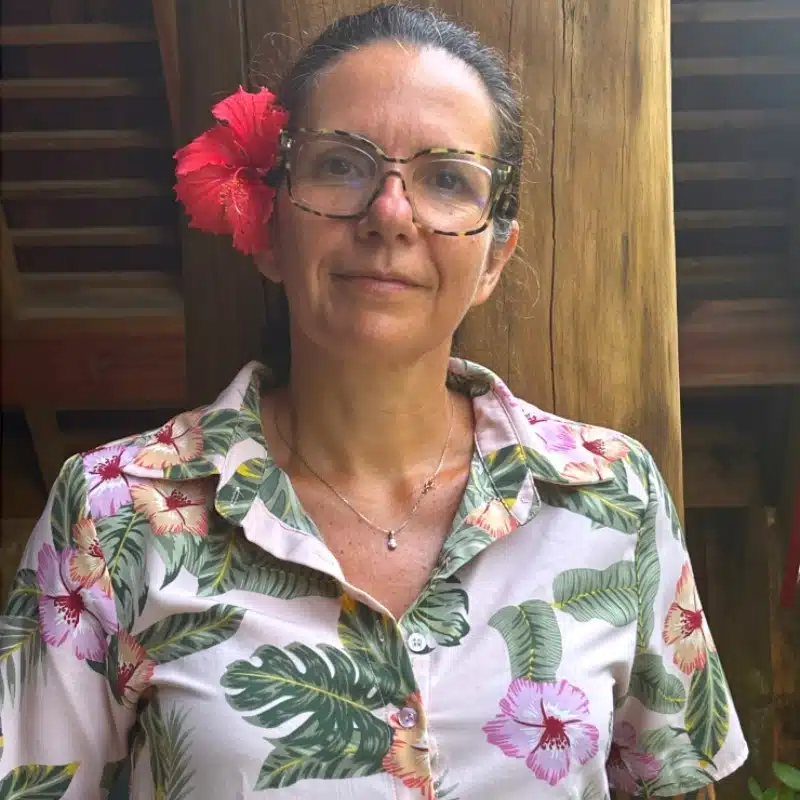
The Pacific’s artistic avant-garde
The Galerie Winkler has become an institution in its home of Papeete. Since 2000, Vaiana Drollet has transformed this historic space into a contemporary creative laboratory. She shared her passion with us and introduced us to an effervescent local scene in which Polynesian artists bring a powerfully questioning perspective to their identity.
You took over the institution in 2000. What was the spark behind that decision?
I decided to have an adventure! Back then, the art landscape was dominated by “travelling painters”, and I respect that heritage. But I wanted to break with that outside perspective to open up a space for Polynesian artists. It was a challenge because we don’t have an art school here. But the internet has allowed young, self-taught artists to embrace the wider world and it’s been like a dormant volcano waking up. The younger generations have really got to grips with their culture because they have this visceral determination to express their true selves, as opposed to aping others.
60 years of history in Papeete
The Galerie Winkler is the oldest art gallery in Tahiti. It was founded in 1964 by Sandy Winkler, an Ecole du Louvre graduate (class of 1952) and an expert working at the Pape’ete courts. For many years, the gallery exhibited paintings in a classic style. However, when Vaiana Drollet took the reins in 2000, the editorial bent shifted to put it at the cutting edge of contemporary Pacific art. While it still has its links with historic artists such as Andreas Dettloff, the gallery now focuses on promoting young creators working in sculpture, painting and street art, and serving as a talent incubator and portal to the international scene.
What does this new wave tell us about contemporary society?
It depicts the unvarnished reality of the Fenua [“land” or “country”] worlds away from the glazed depictions of exotic Tahitian women we were used to seeing. The artists tackle questions about identity, society, the environment and politics, including our nuclear heritage. The contemporary Polynesian aesthetic is defined by that constant tension between tradition and modernity. Street art is a key starting point for the current generation which was brought up on American culture. It freed them, both in terms of what they could say and how to say it. Ancestral conventions aren’t set in stone, they are shaken and transcended by the world as it is today.

A painting by Andreas Dettloff: a Polynesian atoll ringed by white sky-scrapers with a blue lagoon at the centre
How does materiality express this link to the land?
It does this with its many unexpected textures. There is a bodily relationship to materiality. The sculptor Jonathan Mencarelli rends Marquesas Island motifs until they become completely abstract. The artist Tary makes use of irony by affixing a McDonald’s logo to a traditional resin umete [a ceremonial bowl] to juxtapose globalisation with the sacred realm. The painter Tuatahi depicts urban young people who are unemployed yet surrounded by ancestral motifs that speak to mana, the invisible spiritual force that inhabits our islands.

A sculpture by Tahe: three people holding up a traditional bowl with a large wooden McDonald’s “M” on it
Vaiana Drollet: educating perspectives
Vaiana Drollet was just 23 years old when she took over the Galerie Winkler in 2000. At the time, it was a home for “travelling painters”. However, Vaiana had just come back from mainland France and had another vision entirely. As a former art teacher, she brought a mission to her role: she wanted to educate. As she moved from the classroom to the gallery, she lost none of her desire to train people’s ability to look at art and question preconceived ideas. With Vaiana at the helm, the grande dame of Polynesian art galleries became an exacting talent incubator.
To what extent has art education in Polynesia kept pace with the new wave?
The Centre des Métiers d’Art de la Polynésie Française (French Polynesian Art College) has developed enormously. We have moved on from just copying our predecessors to taking inspiration from all over the world. Taunatere is a great example of this. She graduated from the Centre and developed her own technique for working with wood which draws on both sculpture and painting. She deconstructs the raw material then pieces it back together into fragments that have something of a puzzle about them to make organically textured compositions. Her works beautifully illustrate how ancestral skills can be used to create resolutely contemporary art.

A wooden artwork by Taunatere with partial motifs in warm greens and blues, evocative of a flower blooming and a volcano erupting
Does the Fenua have its own contemporary aesthetic?
Absolutely. It is shaped by that clash between tradition and modernity. What makes it unique is its use of traditional motifs not as a fixed kind of ornamentation, but as a living language. Whether it is in images of tiki or tattoo art, these parts of our identity are absorbed and remixed with contemporary ideas. It is an artistic identity which couldn’t exist anywhere but here, in the middle of the Pacific.

A painting by Tuatahi: a young man in a baseball cap and flipflops on a rock, against a background of Polynesian motifs
Visiting Moorea: Tai Anapa, art in its rightful home
To extend the experience beyond the gallery walls, Vaiana wanted to create a unique retreat on the sister island of Moorea. Tai Anapa is a guesthouse with three rooms and three separate worlds given over each year to new artists who reimagine the space from floor to ceiling. “It’s a place to find deep inspiration and converse with others,” she says. “And a way to immerse yourself in the local art scene.”
What perspective do travellers bring to these works?
They often arrive with a set of images already lodged in their imaginations and they expect unruffled landscapes. Instead, they discover a socially conscious, authentic and sometimes rough-hewn local scene. The shock is quite revivifying. They feel moved by it precisely because they sense that art isn’t just decoration for tourists here, it has a vibrancy and a questioning attitude to life. When people buy here, they don’t just leave with a piece of art, they take a part of our real identity with them, the identity of a living culture that didn’t end with Gauguin.

A painting by Tāhiri: a woman in a black dress with flowers on her shoulder in front of pink and orange foliage
Secret Tahiti: Vaiana Drollet’s notebook
- Culture: the Museum of Tahiti and Islands
An unmissable educational space offering an accessible and modern way to understand Polynesian history and culture.
- Eat: Papeete market
The market is the island’s beating heart from first light. Otherwise, head to the Café Roti opposite the town hall to get a feel for the town as it comes to life.
- Nature: Pointe Vénus
This sublime black sandy beach is on the east coast. It is steeped in family history for Vaiana, as her ancestor was the lighthouse keeper.
- Craft: Ken Hardie’s studio
This outstanding wood turner in Faa’a is a living embodiment of arts and crafts, blending traditional techniques with a contemporary vision.
- Must-read: Pina by Titaua Peu
This powerful, uncompromising writer depicts contemporary Polynesian society with elemental force. Unmissable.
Photos credits: ©DR Galerie Winkler ; Andreas Dettloff ; Tahe ; Taunatere ; Tuatahi ; Tāhiri

PONANT takes you there
Explore the vibrant modern culture of the Pacific