

 Explore to inspire, a PONANT podcast
 PONANT's cruises
7 Expressions of Culinary Diplomacy in the Arctic
There are many ways to break the ice.
Some require steel.
Others begin with a meal.
In January 2027, both happen at once.
As Le Commandant Charcot presses into the frozen waters of the Gulf of Bothnia, a different kind of gathering unfolds on board the world’s only luxury icebreaker—one shaped not by protocol, but by philosophy. Around the table are voices that have served at the center of global power: an executive chef who led the White House kitchen for nearly three decades; a culinary force who helmed the Élysée Palace kitchen before becoming Ambassador for French Gastronomy; a diplomat who represented France in three of the world’s most consequential capitals; and the founder of the world’s most exclusive gastronomic society—a man guided by the belief that if politics divides people, a good table brings them together.
From January 15–23, 2027, a nine-day voyage from Kemi to Helsinki becomes more than a winter passage through the Baltic. It becomes a rare convergence of gastronomy, diplomacy, and polar exploration.
Here are eight ways this Arctic gathering redefines diplomacy through cuisine:
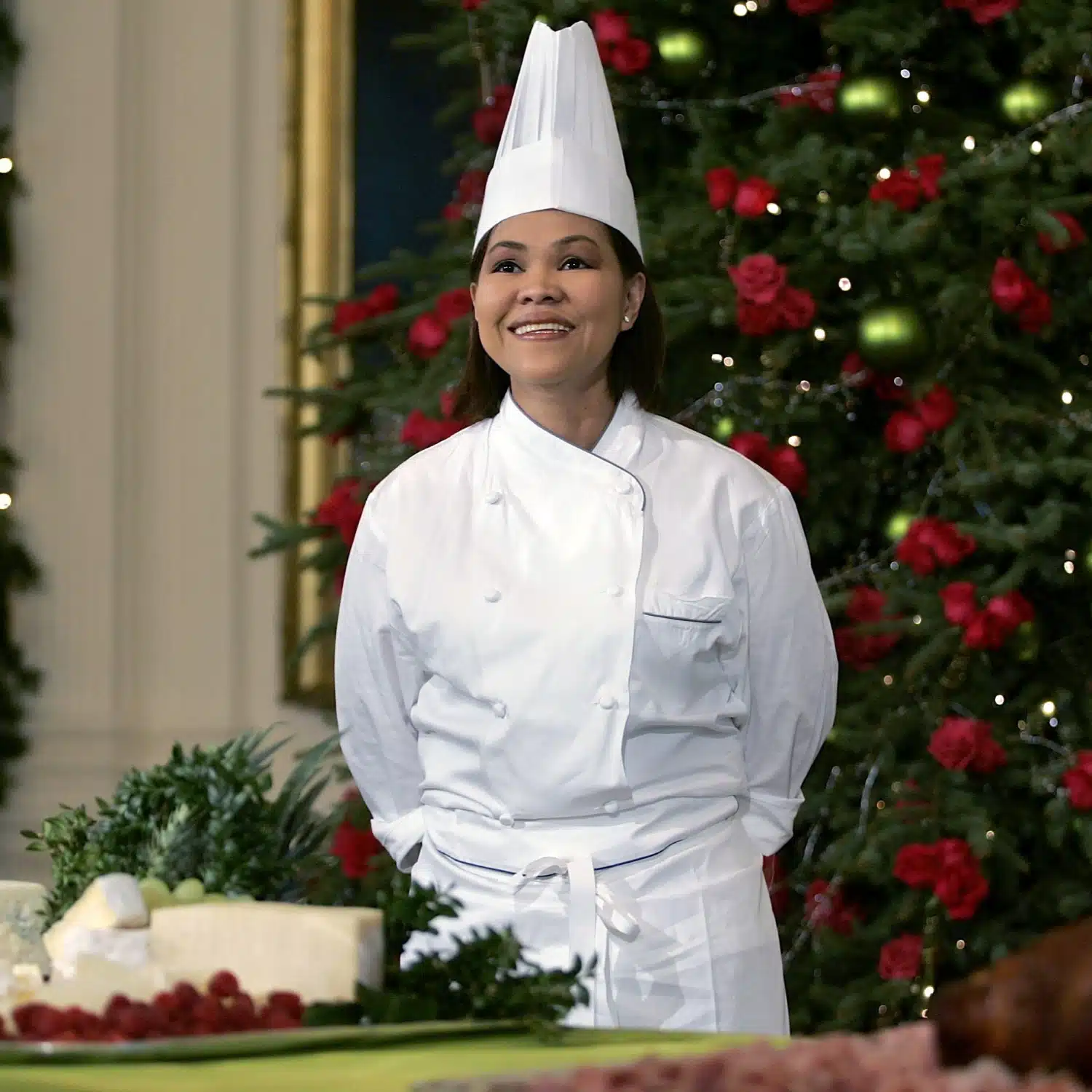
Cristeta Comerford, former Executive Chef of the White House, brings decades of culinary diplomacy to the table on this voyage through the Gulf of Bothnia, just south of the Arctic Circle. (Photo Credit: Chip Somodevilla | Getty-Images)
1. A White House Perspective on Culinary Diplomacy
Cristeta Comerford, Former White House Executive Chef
For nearly thirty years, Cristeta directed the White House kitchen, serving five U.S. presidents across eight administrations and orchestrating more than fifty State Dinners. In that setting, food was never simply food. Every ingredient carried meaning, every menu acknowledged culture, and every detail mattered.
On board Le Commandant Charcot, she reflects on her philosophy that “food is a social facilitator and a powerful conversation tool: a simple yet effective way to spark dialogue at the table. Culinary diplomancy is an essential reality. Every meal, especially State Dinners, is a unique opportunity. There are no second chances. Everything has to be perfect the firs time.”

The former Head Chef at the Élysée Palace and France’s Ambassador for Gastronomy, Guillaume Gomez shares the traditions and cultural heritage of French cuisine aboard Le Commandant Charcot. (Photo Credit: Frederique Touitou)
2. French Gastronomy at the Highest Level
Guillaume Gomez, Former Head Chef at the Élysée Palace; currently France’s Ambassador for Gastronomy
Having spent more than two decades in the kitchens of the Élysée Palace, Guillaume ultimately served as Head Chef to four French presidents, taking part in international events such as the G8 and G20 summits. Appointed Ambassador for French Gastronomy in 2021, he champions cuisine as living heritage—a reflection of terroir, memory, and national identity.
In the Arctic winter, his perspective feels especially resonant. Culinary tradition, like culture itself, endures through time, climate, and change.

Throughout the voyage, Sylvie Bermann, a diplomat and Ambassador Extraordinary and Plenipotentiary of France, discusses insights gleaned through her decades of international diplomacy and cultural exchange.
3. Diplomacy in Practice
Sylvie Bermann, Diplomat and Ambassador Extraordinary and Plenipotentiary of France
A seasoned diplomat, Sylvie served as France’s ambassador to China, the United Kingdom, and Russia—the first woman to hold each of those posts. During her tenure, she navigated complex geopolitical landscapes shaped by nuance and trust.
Her insights deepen the conversation aboard Le Commandant Charcot. Where chefs speak of hospitality and symbolism, Sylive reveals the broader architecture of diplomacy and the delicate interplay between culture and policy.

Gilles Bragard, founder of the Club des Chefs des Chefs, the international association connecting the personal chefs of heads of state around the world, shares his perspective on the global traditions of gastronomy. (Photo Credit: @Club des Chefs des Chefs)
4. The Philosophy That Brings Them Together
Gilles Bragard, Founder Club des Chefs des Chefs
Nearly five decades ago, Gilles Bragard founded the Club des Chefs des Chefs (Club of Chefs to Heads of State) to unite the personal chefs of heads of state—one per nation—in friendship and cooperation. Often described as the “G20 of gastronomy,” the organization exists to safeguard culinary traditions while fostering mutual respect.
His guiding conviction—that a good table can unite where politics divides—frames this voyage. Here, surrounded by Arctic ice, that belief feels elemental.

Le Commandant Charcot advances through the frozen waters of the Gulf of Bothnia, a region where winter transforms the Baltic into a vast Arctic landscape. (Photo Credit: ©PONANT Julien Fabro)
5. Aboard the World’s Only Luxury Icebreaker
Le Commandant Charcot
Le Commandant Charcot is uniquely suited to host such dialogue. As the world’s only luxury icebreaker, she navigates ice-covered waters inaccessible to conventional ships. Her PC2-class hull allows her to advance deliberately through the frozen Gulf of Bothnia, while state-of-the-art systems ensure comfort and environmental sensitivity.
On this voyage, breaking the ice is not only a metaphor, it is movement.

During winter, the Gulf of Bothnia transforms into a frozen seascape, with drifting sea ice and snow-covered boreal forests along the coasts of Finland and Sweden. (Photo Credit: ©StudioPONANT Morgane Lanco)
6. Winter at the Gateway to the Arctic
The Gulf of Bothnia
Between Finland and Sweden, the Baltic settles into luminous stillness. The period of kaamos (polar night) reduces daylight to a lingering blue twilight. Snow gathers along the shores of Lapland. In Kemi, an ephemeral snow castle rises from the frozen coast. In Luleå, lantern light glows against centuries-old wooden houses. Stockholm’s archipelago appears sculpted and hushed beneath winter skies. Cold clarifies the senses, and silence heightens presence.

Aboard Le Commandant Charcot during a winter expedition cruise in the Far North, guests gather for dinner to share cuisine and conversation. (Photo Credit: ©PONANT Gilles Trilla)
7. Nordic Traditions at the Table
Where Winter Shapes the Plate
Winter cuisine reflects its environment: salmon cured with dill, root vegetables drawn from frozen earth, berries preserved from fleeting summer light. Meals center on warmth and gathering. When regional traditions meet chefs who have cooked for presidents, something compelling emerges—a conversation between local and global, heritage and innovation. Flavor becomes a language shared across borders.
January marks a threshold. A pause between what has been and what may be. From January 15–23, 2027, this voyage through the Gulf of Bothnia offers more than passage through Arctic waters. It offers encounters and cultural connections.
Where steel parts the Baltic ice, conversation crosses borders. And a shared meal draws the world closer.

Aboard Le Commandant Charcot, culinary diplomacy welcomes the New Year in the heart of the Gulf of Bothnia with the enchanted landscapes of Lapland and the polar night as its backdrop.