

 Explore to inspire, a PONANT podcast
 PONANT's cruises
Through its alliance with The Explorers Club, an international society dedicated to advancing scientific exploration, PONANT EXPLORATIONS invites Explorers Club Science Grantees aboard its luxury icebreaker Le Commandant Charcot to conduct research and enrich the expedition experience for guests. Expedition Voices is a new blog series introducing the scientists behind these projects and the discoveries unfolding in some of the word’s most extreme destinations. Here we are pleased to share our premier edition.
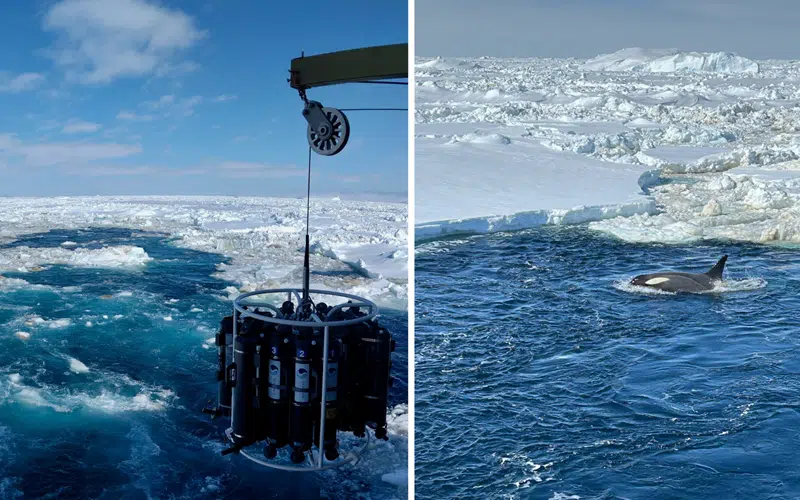
PolarSOWCr – Informing the Search for Life on Ocean Worlds (Photo by Miriam Naseem)
At the edge of Antarctica, the Weddell Sea is silent in a way that feels almost cosmic. Ice stretches to the horizon. The air is sharp, crystalline. Beneath the frozen surface, however, lies a hidden world—dense, pressurized, and largely untouched by sunlight. It is here, in one of the most extreme environments on Earth, that scientists search for answers to one of humanity’s oldest questions: Can life exist in outer space?
Two researchers recently set out to explore that possibility. Not by looking up at the night sky, but by drawing water from the depths of Antarctica’s ocean.
To reach this formidable and fascinating region, Mariam Naseem and Marc Neveu of the University of Maryland/NASA Goddard Space Flight Center, found themselves aboard Le Commandant Charcot from December 2025 to January 2026.
Traveling as Science Grantees through PONANT EXPLORATIONS’ alliance with The Explorers Club, the reserachers were able to conduct fieldwork to support their project, PolarSOWCr: Informing the Search for Life on Ocean Worlds. Their goal was to collect deep water, sea ice, and brine samples from environments that resemble contions on icy moons beyond our solar system.

Research during PolarSOWCr – Informing the Search for Life on Ocean Worlds (Photo by Miriam Naseem)
Why does this research matter?
Those moons include Europa, which orbits Jupiter, and Enceladus, which circles Saturn. Both are known as “ocean worlds”—icy bodies believed to contain vast liquid oceans beneath thick outer shells of ice. These hidden seas may hold key ingredients for life: carbon, nitrogen, and chemical energy.
Through missions such as NASA’S Europa Clipper and the European Space Agency’s (ESA) JUICE (JUpiter ICy moons Explorer) missions, international space agencies are now studying them to assess their potential habitability.
But to understand what spacecraft detect on those worlds, scientists must first understand how ocean material behaves when exposed to space.
That is where Antarctica becomes essential.
On December 30 and 31, 2025, during their research on board Le Commandant Charcot, Naseem and Neveu collected two of the deepest water samples ever obtained. These waters came from the Weddell Gyre—a massive circular current, or rotating ocean system, in the Southern Ocean—and from the deep Antarctic Circumpolar Current. Both regions are permanently ice-covered and largely isolated from surface waters.
Formed under pressures of 50 to 100 bar—comparable to depths of 500 to 1,000 metres or roughly 1,600 to 3,300 feet—beneath icy moons, these samples are among the closest Earth analogs to extraterrestrial oceans yet collected.

Testing Equipment on PolarSOWCr – Informing the Search for Life on Ocean Worlds (Photo by Miriam Naseem)
What will the research contribute to?
Back in the laboratory at UMD/NASA Goddard, Naseem and Neveu will introduce these samples into the Simulator of Ocean World Cryovolcanism, known as SOWCr (pronounced “soaker”). This custom-built vacuum chamber mimics the near-airless conditions of space.
By injecting Antarctic water into SOWCr, scientists simulate cryovolcanism—the process by which subsurface ocean material erupts through ice into vacuum, as has been observed on Saturn’s moon Enceladus.
Key Findings
“Our primary findings will come after we inject the Antarctic samples into SOWCr and characterise how eruptions into space alter ocean material,” the team explains in their post-voyage report. Understanding those chemical changes is critical to interpreting data from space missions which are currently investigating Europa’s potential plumes.
The voyage itself was foundational. “We would not have been able to conduct our research and obtain novel deep water samples in perennially ice-covered regions without the polar icebreaker Le Commandant Charcot,” Naseem and Neveu note.

The Explorers Club Science Grantee Miriam Naseem (Photo by Miriam Naseem)
For Naseem, the experience extended beyond the laboratory. “It is impressive to see the focus and dedication to promoting science on a cruise vessel,” she reflects. The ship’s oceanographic facilities are fully equipped for serious research, yet they exist within a setting that also hosts travelers in extraordinary comfort on journeys to one of the planet’s most remote regions.
That balance is what makes the experience distinctive. “Charcot is a state-of-the-art polar icebreaker carrying paying tourists while also enabling groundbreaking research,” they write. “The fact that they can manage these competing priorities is amazing.” A dedicated science coordinator on board ensures research objectives remain achievable, even within a dynamic expedition itinerary.
Meaningful Connections
Perhaps most meaningful was an evening conversation over dinner. Naseem spoke with a guest and her daughter about women in science and leadership. “Representation and providing a platform for early-career scientists are important,” she shares. “I could tell that she and other passengers were really happy to see researchers from various backgrounds and career stages carrying out groundbreaking research on Charcot.”
In that moment, exploration became personal.
The deep waters of the Weddell Gyre may seem distant from the moons of Jupiter or Saturn. Yet the bridge between them is built here, in careful sampling and rigorous experimentation. By studying how Antarctic ocean material transforms in simulated space conditions, researchers refine the tools that will one day help identify potential signs of life beyond Earth.
The ice is silent. The questions are not.
And from the depths of Antarctica, a new chapter of planetary discovery quietly begins.