

 Explore to inspire, a PONANT podcast
 PONANT's cruises
Once upon a time, there were the Antarctic pioneers…
Film-maker Henri de Gerlache, a great-grandson of Belgian pioneer Adrien de Gerlache, has just returned from another voyage to the Antarctic with PONANT EXPLORATIONS aboard L’Austral. Film camera in hand, this storyteller of the Far South is preparing an ambitious documentary series on the heroic age of polar exploration. The epic story he tells is a collective one in which humility in facing the elements outweighs the race to conquer the poles.
Why does your series focus on the collective perspective, rather than a lone hero?
While I was preparing an exhibition in Antwerp, I learned of the rich correspondence between the great polar pioneers: Adrien de Gerlache, Roald Amundsen, Frederick Cook, Robert F. Scott, Jean-Baptiste Charcot and others… these men virtually worked as a team. And yet history has often chosen to remember individual exploits in pursuit of national glory, even though in reality each person’s progress helped the others push further forward.
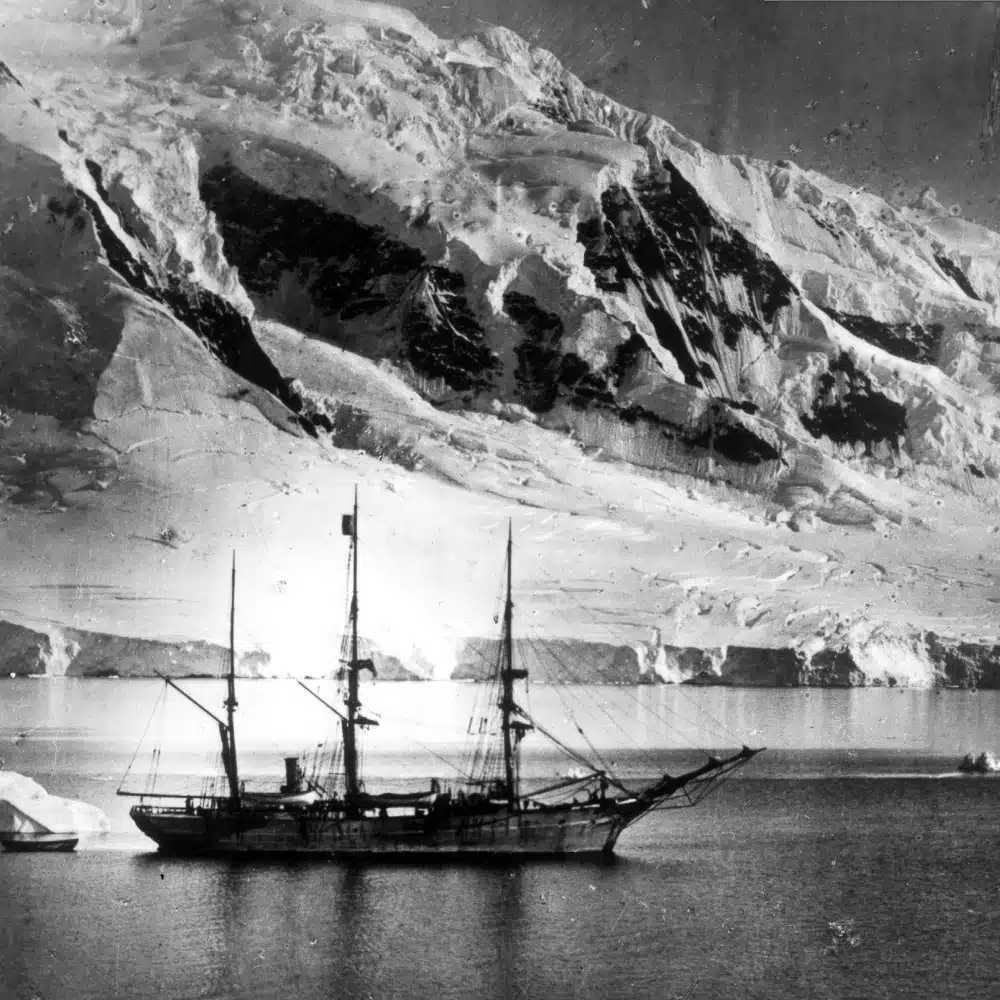
The Belgica sailing in the “Gerlache Strait”, 1898 ©Gerlache Polar Memory
Roald Amundsen reached the South Pole first, in 1911, largely as a result of what he had learned from Frederick Cook during the Belgian Antarctic Expedition (1897–1899, editor’s note), when they were forced to overwinter together on the Belgica. The ability to tackle the continent from all angles was attributable to a powerful combination of circumstances. There was competition, of course, but it was healthy. When facing such extreme conditions, one man’s ego didn’t count for much: sharing information was vitally important to success.
The epic story of the Belgica
On August 16, 1897, the Belgica – a wooden three-masted ship with a reinforced hull – left Antwerp on the first Belgian Antarctic Expedition, later renamed the Belgica Expedition. Its commander, the young Adrien de Gerlache, was a man with an ambition: to uncover the mysteries of the Antarctic, the last unknown land. On board were fewer than twenty men of different nationalities, including two whose names would soon become legendary: American doctor Frederick Cook and a young Norwegian lieutenant named Roald Amundsen. In April 1899, after more than a year of radio silence, a telegram was sent: the Belgica was returning in triumph, having endured 15 months in Antarctica and the very first polar overwintering in history, and bringing back a wealth of scientific results.
Did the experience they gained during their Arctic expeditions play a role in their exploration of Antarctica?
Yes—even though this was a colonial era, a time when people believed empires and Western power could conquer anything. But Antarctica proved bigger than they were. Amundsen had sufficient humility to spend five years in the Far North learning from the Inuit people before setting off for the pole. The idea that people who had always lived there might have something to teach us was very new at the time.
Did this correspondence between the first explorers of Antarctica lay the foundations for future international cooperation over the “White Continent”?

Some expeditions, like the Belgica’s, brought together several nationalities, scientists included. These men were conducting research: they weren’t setting out just for the privilege of planting a flag. Without really intending to do so, they laid the groundwork for international cooperation, which would later take meaningful shape with the 1959 Antarctic Treaty. It’s no coincidence that the twelve signatory countries all had a rich polar history and explorers from that same heroic era.
My grandfather Gaston de Gerlache became part of that story by establishing the Belgian Roi Baudouin scientific base in Antarctica in 1957, during International Geophysical Year, following the first bases [Chilean in 1947, Australian in 1954, American in 1955, Russian and French in 1956, editor’s note]. Even today, this 14-million-square-kilometre continent remains an extraordinary global laboratory dedicated to peace.
A choral fresco amid the pack ice
Scheduled for late 2027, Henri de Gerlache’s next documentary series – Antarctica: The Age of Heroism – will trace the intertwined paths of the major figures of polar exploration between 1895 and 1915. To film this large-scale historical fresco, he has surrounded himself with specialists in extreme conditions: Laurent Chalet, cinematographer of March of the Penguins, and sound engineer and drone operator Frédéric Heinrich. This joint “choral work” highlights the vital collaboration between Adrien de Gerlache, Charcot, Amundsen, Scott, and Shackleton.
During this trip to Antarctica with PONANT, did you follow the Belgica’s precise route?
For the filming, we brought along photographs from the time so we could recreate the same framing. The landscapes haven’t changed at all. It’s striking to imagine what daily life must have been like for the crew back then, facing the cold and that leap into the unknown, entirely on their own in the middle of the ice: the Belgica was a 34-metre wooden ship with an engine that produced just 35 horsepower.

You quickly learn that it’s always the elements that call the shots. On our way back through the Drake Passage, we hit ten-metre troughs with 150 km/h winds. From the bridge, with waves reaching as high as the fifth deck, I found myself thinking that the Belgica simply wouldn’t have made it in those conditions.
Your grandfather Gaston de Gerlache spoke of a real “addiction” to the Far South…

Antarctica is a unique place: completely uninhabited apart from scientific bases; here, the elements exist in their purest form. There’s a deeply absorbing silence there that you just don’t find anywhere else. All explorers say the same thing: once you’ve seen these landscapes, the urge to go back is irresistible.
That fascination runs through the ages. Despite terrible hardships and extreme conditions, those pioneers already felt that same deep need to return to the ice. That’s the real paradox of the continent: its harshness constantly reminds you of your vulnerability, yet its absolute beauty draws you back like a magnet.

Adrien de Gerlache, 1897 ©Gerlache Polar Memory
Family portraits
-
Adrien de Gerlache (1866-1934): a sailor and explorer who led the first scientific expedition to Antarctica aboard the Belgica and overwintered there for the first time, from 1897 to 1899.
-
Gaston de Gerlache (1919-2006): an aviator and explorer who was instrumental in Belgium’s involvement in the International Geophysical Year by establishing a scientific research base in Antarctica – the Roi Baudouin Base – in 1957 and 1958.
-
Henri de Gerlache (1973): author and director of numerous documentary films, he grew up with the “White Continent” as a constant backdrop. In 2007, he directed The Legacy of Antarctica, retracing – through previously unseen archives and extraordinary testimonies – the story of his forebears’ exploration of Antarctica.
How do you see your role as a documentary filmmaker?
The last thing I want is to come across as preachy. I’d rather tell stories that draw people in. I showed my film “The Legacy of Antarctica” aboard L’Austral, in the very places where the story unfolded. What I noticed is that audiences – who often just picture a white continent and a few names like Roald Amundsen or Robert Falcon Scott – end up fascinated as they discover an adventure that’s infinitely more diverse and collective.
What strikes them most is the total lack of communication back in those days. Despite all the interactions they’d had beforehand, once they had set off, there was no certainty about when they would return, and no way to send warning messages. Through my documentaries, I try to convey the idea that, faced with today’s climate emergency, humanity will need to show that same remarkable adaptability.

If you could send a message in a bottle back through time, what would you say to your great-grandfather Adrien de Gerlache?
I’d tell him: “Hang in there, you’re going to make it!” During the polar night as they overwintered, they lost a man and had serious doubts about their chances of survival. Trapped in the pack ice, they only managed to break free in March the following year, which is extremely late in the season. Their greatest fear was having to face another year in the ice.
An ordeal like that would have been fatal for many—the lack of provisions, the harsh conditions and the psychological strain were immense. But he kept going. He came through it very well, paving the way for all the remarkable expeditions that followed. It was in the wake of that success, and thanks to regular correspondence, that men like Jean-Baptiste Charcot, Robert Falcon Scott and Ernest Shackleton went on to distinguish themselves on the “White Continent” in turn.
Photo credits: CLPB/Belgica films; Gerlache Polar Memory; StudioPONANT/Sarah Leïla Payan; Romain Farge; Sylvain Adenot; Olivier Blaud

Let PONANT take you there
Follow in the wake of the pioneers of polar exploration