


 Explore to inspire, a PONANT podcast
 PONANT's cruises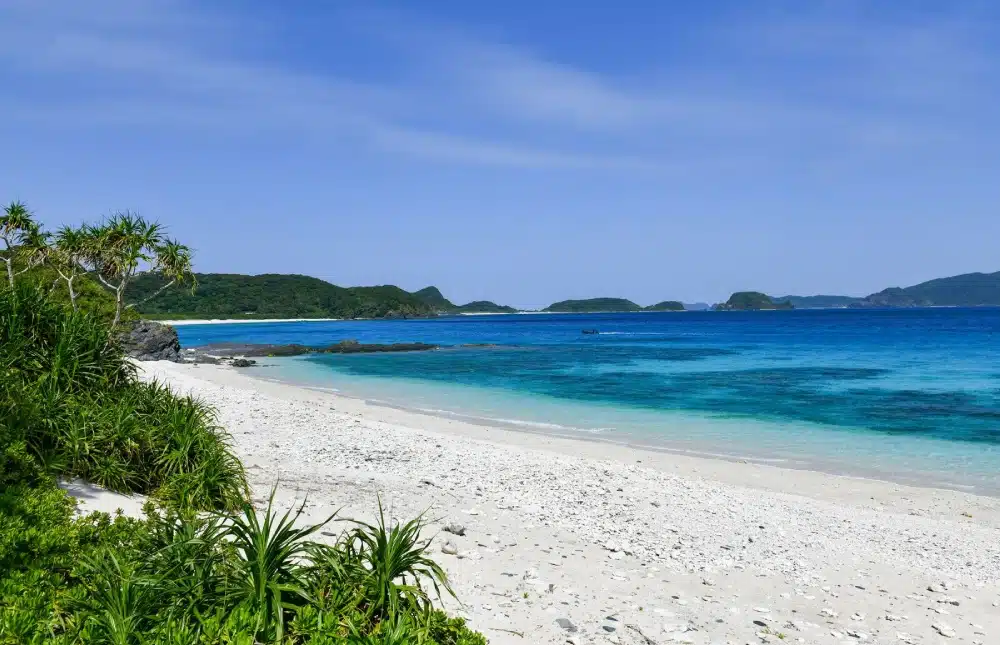
Five unforgettable experiences
Crystal-clear waters, lush jungles, pristine beaches: the subtropical islands of Japan offer a paradise setting. Travelling in these archipelagos at the end of the world is a gentle journey full of discoveries, a thousand miles away from the hustle and bustle of Japan’s big cities. A different kind of Japan.
1. Kerama Blue: Diving in unspoilt lagoons
Turquoise, azure, sapphire, sky blue: there is no shortage of adjectives to describe the blue waters of Japan’s subtropical islands. From bay to lagoon, beach to reef, discover shades that echo each other as far as the eye can see, like an immense mosaic composed by the most subtle of painters.
The most astonishing colour is undoubtedly to be found in the heart of the Kerama archipelago: the famous “Kerama blue”, a shade unique in the world, close to cobalt and navy blue, whose purity comes from the good health of the local corals. To admire it, head to Zamami Island, a perfectly preserved tropical gem, and the ideal place to enjoy swimming and relaxation.

The Kerama Islands are home to many natural treasures, such as the coral reefs of Zamami Island. It’s one of my favourite places to visit, especially for its white sandy beaches.
Kento Lafay, naturalist guide for PONANT EXPLORATIONS
2. Deep green: Listen to the heartbeat of the jungle
Most of the forests on Japan’s subtropical islands are entirely unspoilt, offering ideal places to explore for lovers of trees and rare birds.
On Amami-Oshima, the Kinsakubaru primary forest is adorned with mosses and giant ferns, creating a deeply dreamlike atmosphere. Iriomote, an island listed as a UNESCO World Heritage Site, is teeming with endemic species, the most famous of which is undoubtedly the Iriomote cat, one of the rarest felines in the world. Discover these islands on foot, following the paths that wind beneath the foliage, or by boat along the crystal-clear rivers that flow through them. With the soundtrack of birdsong, the murmur of waterfalls, and the impenetrable silence of ancient nature.
These islands enjoy a lush environment that has earned them the nickname “the Japanese Hawaii.
Kento Lafay, naturalist guide for PONANT EXPLORATIONS
3. Mineral grey: refocusing on the origins of Japanese beliefs
A must-see attraction on the island of Okinawa, the Seifa-Utaki rock sanctuary, is of particular importance to the people of the archipelago. It was there, in the heart of a jungle rich in delicate shades of green, that the mythical mother of their pantheon is said to have first appeared on Earth. In medieval times, these places were off-limits to men, and only women were allowed to lead prayers.
Today, the astonishing stone formations of Seifa-Utaki are still considered sacred. Perhaps you’ll feel the power it exudes? An opportunity for a moment of introspection in the heart of a magnificent UNESCO World Heritage Site.
4. Soft green: rejuvenate yourself by embracing the local way of life
Okinawans have the longest life expectancy in the world. Why? Some doctors point to the quality of their diet, which features local fruits and vegetables – such as the flavourful shikuwasa lemon and mozuku seaweed, rich in antioxidants. Others emphasise closeness to nature and the importance of human connections based on mutual support. One thing is certain: staying in the archipelago is good for both body and soul.
These islands call for refocusing on the essentials, slowing down and finding your balance, your ikigai.
Kento Lafay, naturalist guide for PONANT EXPLORATIONS.
Ikigai or the pursuit of happiness
A fundamental principle on Okinawa, ikigai translates as “reason to live” or “reason to be happy”. There are no rules: it’s up to you to discover your own sources of happiness, through encounters and moments of inspiration. Many anthropologists consider ikigai to be one of the reasons behind the extraordinary longevity of the Okinawans, as the pursuit of serenity promotes physical and mental health. An invitation to joyful introspection.
5. Bingata red: admire ancestral craft techniques
Japan’s subtropical islands also offer an opportunity to discover centuries-old skills practised by artisans who are deeply attached to their rich heritage. … and eager to share it. In Okinawa, textiles take centre stage, with no fewer than thirteen techniques using fine materials and motifs inspired by nature, enhancing a long animist tradition. In the Ryukyu archipelago, working with clay and glass conveys a unique understanding of natural forces, a blend of respect and wonder.
Our favourite is undoubtedly Ryukyu Bingata (“Ryukyu red style”), a dyeing technique that uses local pigments in particularly vivid colours. Artisans apply them by hand to natural textiles, using designs that vary according to their imagination: flowers, birds and abstract patterns combine to form unique pieces of extraordinary brilliance.
An independent region until the nineteenth century, Okinawa developed a unique heritage, influenced by neighbouring countries. Its dances, architecture, colourful fabrics and cuisine reflect Chinese, Thai and Japanese influences.
Kento Lafay, naturalist guide for PONANT EXPLORATIONS
Okinawa, the birthplace of karate
Although the art of unarmed self-defence has been practised in Okinawa since time immemorial, the spread of combat techniques from China in the thirteenth century led to the emergence of a new discipline: karate. The first to take it up were ordinary citizens, who were forbidden to carry weapons, as the use of swords was reserved for samurai. Karate has evolved since its origins, but its philosophy remains the same: a delicate balance between spiritual quest and physical power.
Photo credits: ©StudioPONANT : Thibault GARNIER ; ©iStock ; @GettyImages : Ippei Naoi

Let PONANT take you there
Set sail for Japan’s subtropical islands