

 Explore to inspire, a PONANT podcast
 PONANT's cruises

With Sylviane de Tracy, in the heart of the Philippines
In the Visayas in the centre of the Philippine archipelago, the islands appear one after the other, weaving a tapestry of coral reefs, coconut groves and villages facing out to sea. Sylviane de Tracy, Cruise Research & Development Director at PONANT EXPLORATIONS, made a scouting trip there with a view to offering a voyage to the Philippines that is even more immersive and authentic than ever.
A journey between land and sea
Between the South China Sea and the Pacific Ocean, the Philippines comprise more than 7,000 islands, naturally connected by the sea. “Discovering the Philippines by sea is pretty self-evident given the geography. In the Visayas, rather than looking at a map, distances are gauged through the crossings, changes of course and toing-and-froing dictated by this scattered archipelago,” notes Sylviane de Tracy. However, on these remote islands, maritime infrastructure is often very basic, “so most landings on the shores will therefore be made directly in an inflatable boat,” she explains.
In the Philippines, travelling by land is an experience in its own right. Winding through villages and passing alongside markets, the roads are populated by tricycles (a sort of tuk-tuk motorcycle), jeepneys (local buses), habal-habals (small motorbikes that can carry two passengers behind the driver, ideal for car-free islands), bicycles and animals, while rice is still dried by the side of the road. “On Biri Island, travelling through the mangrove forest on the back of a habal-habal to reach the shore featuring rock formations and turquoise pools sculpted by the wind and tides gives you a real sense of freedom”, explains Sylviane de Tracy.
In the Philippines, American Jeeps abandoned after the Second World War have been converted into public transport by extending the rear of the vehicles and painting them in bright, eye-catching colours.“Jeepneys are becoming real works of art, a source of great pride for their drivers”, indicate Sylviane de Tracy.
The Visayas: an archipelago in a class of its own
Situated between Luzon and Mindanao, the Visayas form the maritime heart of the Philippines. This string of islands, which includes Cebu, Leyte and Bohol, has fewer visitors than other parts of the country due to the remoteness of some of the destinations and the still limited infrastructure. Their island location helps to preserve their authenticity and makes the dry season, between February and May, the ideal time to explore them.
When the islands make themselves heard
Arriving by sea profoundly changes your perception of the area. Even before the houses on the shore can be made out, the first sounds of the village reach the ship. “Birds, cockerels and children’s laughter… You experience the island atmosphere before you’ve even set foot on it,” recalls Sylviane de Tracy. Then the coastline comes into view, along with the coconut palms and the first fishing boats as you approach the villages.

A journey to the heart of the island communities
In this archipelago, which remains largely untouched by mass tourism, the crossings are gradually fostering a closer connection with the islands and their inhabitants. Sylviane de Tracy recalls arrivals when the whole village would gather on the shore, a sense of spontaneity that has become rare in some very popular destinations. “In some villages, the arrival of a ship brings the whole community together: schools sometimes close for a few hours and the children welcome the visitors with traditional songs and dances.”

Everyday life is still deeply shaped by the sea and the skills associated with it. Here, people build outrigger canoes, weave plant fibres for fish traps or mats, prepare natural dyes and pass on knowledge of medicinal plants. “The Philippines is home to some magnificent craftsmanship and wickerwork items. It is this immersive aspect that makes these stopovers so enriching,” observes Sylviane de Tracy.
Under the surface
From one island to the next, the sea guides the journey. Accompanied by a guide, you can don fins, a mask and a snorkel to explore particularly rich reefs, where the corals appear at shallow depths in remarkably clear water. “Even when the weather turns overcast, visibility remains astonishing; in just a few minutes, we had already spotted a dozen turtles,” says Sylviane de Tracy, who also advises you not to miss the opportunity to admire the fabulous coral reefs in Limasawa.

Composing with the archipelago
For over a month, Sylviane de Tracy visited around twenty sites; some were ultimately selected, while others were ruled out in the light of the realities she observed on site. “We needed to ensure a real variety of experiences, alternating between cultural approaches, volcanic landscapes, visits to villages and exploring the sea,” she explains.

Samar National Park, a green oasis in the Philippines, is one of my favourite places. You can explore it on a hike with local nature guides, discovering birds and medicinal plants, or in a traditional wooden canoe along the Ulot River.
Sylviane de Tracy, Cruise Research & Development Director at PONANT EXPLORATIONS

Behind these decisions lies all the work involved in planning exploration routes. Some islands instantly win you over with their landscapes but lack the necessary infrastructure to accommodate a ship without disrupting local daily life; others, on the contrary, reveal unexpected potential.
“We adapt to the islands, never the other way round,” points out Sylviane de Tracy. An approach that runs through the entire project and involves carefully observing how these communities live before even considering a stopover there. Far from the busy major ports frequented by large-capacity ships, the journey takes on a different pace, one that pays closer attention to the islands and their inhabitants.
The soul of the Visayas
At the end of this scouting trip, however, it is neither the coral reefs, the coconut groves, nor even the volcanic landscapes that first spring to mind for Sylviane de Tracy. “It is above all the Filipino people who give the journey its true depth,” she says. Throughout the Visayas, you find this same way of welcoming and greeting people with an almost instinctive generosity, whether in remote villages or port cities.

The children of Limasawa
Among Sylviane de Tracy’s most vivid memories, her arrival in Limasawa – an island that had been hit by a devastating cyclone a few years earlier – often stands out. To help the children to find their bearings again after the disaster, the local residents set up singing, drawing and music workshops. To this day, the village’s young people welcome visitors with songs about nature and drawings they have created together.
A scene that perhaps captures better than any other the spirit of the Visayas: a deeply island-based relationship with the land, characterised by resilience, enthusiasm and openness to others.

A little history
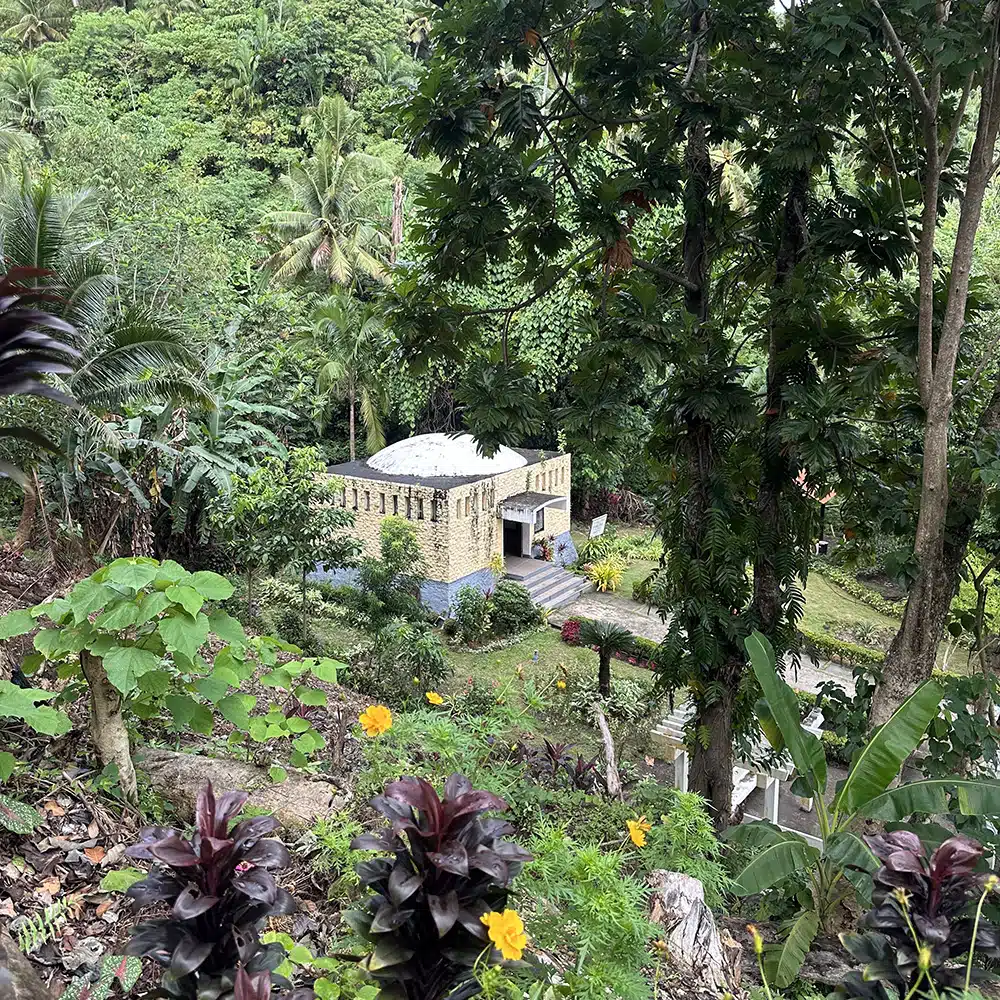
Limasawa: the origins of Christianity in the Philippines
Limasawa holds a unique place in the history of the Philippines. It was here that Ferdinand Magellan landed in 1521 and that, in the presence of the Rajah Kolambu, one of the first Christian masses in the archipelago was celebrated. A few weeks later, however, the expedition took a dramatic turn; the Spanish navigator was killed on Mactan near Cebu, during a clash with the men of Lapu-Lapu, a local chieftain who became a symbol of resistance. A large cross and a small mausoleum in Limasawa serve as a lasting reminder of this seminal event in a country that has become the leading Catholic nation in Asia.

On Marinduque, the Moriones Festival
Every year during Holy Week, the island of Marinduque hosts the Moriones Festival, one of the most important religious celebrations in the Philippines. Participants parade through the streets in Roman costumes and wear impressive wooden masks during processions blending folk theatre, penance and Catholic devotion. During the stopover in Marinduque, you will be able to watch the various stages involved in making these masks, which are emblematic of the island.

Iloilo: the cultural capital of the Visayas
On the island of Panay, Iloilo is an unmissable destination for history and culture buffs. Long prosperous thanks to sugar cane cultivation, which has shaped its economy and architectural heritage, the region is also renowned for its delicious mangoes. Stroll among historic mansions, centuries-old churches and colonial buildings, then delve into the Visayas’ past by exploring the archaeological, ethnographic and historical collections in the city’s museums.
Photo credits: ©PONANT/J. Fabro/S. De Tracy; ©StudioPONANT/O. Blaud

PONANT takes you there
Explore the natural and cultural treasures of the Visayas