

 Explore to inspire, a PONANT podcast
 PONANT's cruises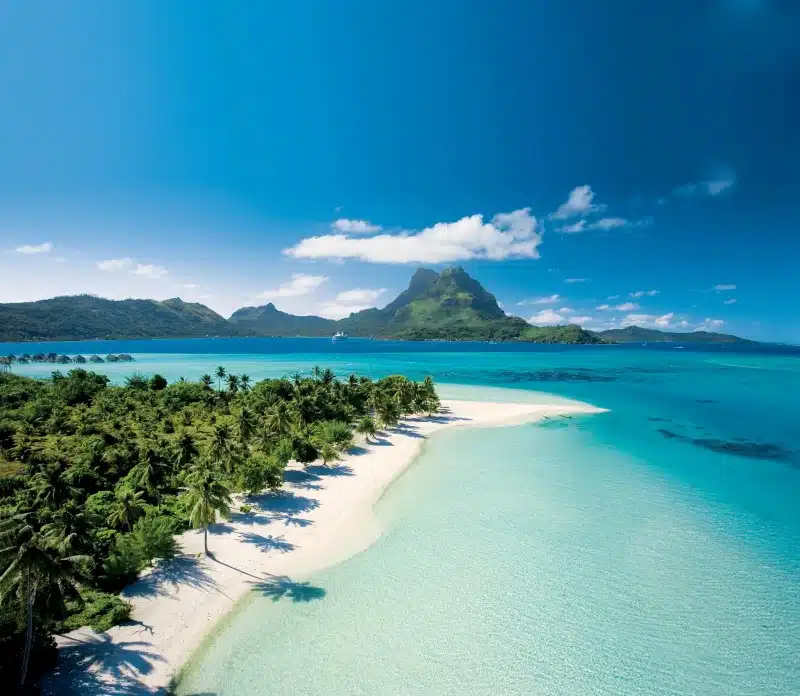
“We are all children of the sea!”
Beyond idyllic atolls and lagoons, travelling through Polynesia also means discovering a thousand-year-old culture that has been undergoing a complete revival over the last forty years. A closer look at “la Polynésie vue par un Polynésien” (Polynesia through Polynesian eyes) with Tahiarii Pariente, lecturer-guide aboard Paul Gauguin, cultural consultant and navigator.
Tahiarii Yoram Pariente, cultural ambassador
Born in Tahiti, Tahiarii Pariente spent his childhood between Polynesia and the beaches of the English Channel, developing a passion for the sea and sailing. In the early 2000s, he returned to Raiatea, homeland of his ancestors, driven by the desire to acquire ancestral knowledge so that he, in turn, could pass it on to younger generations. He also trained in Hawaii in traditional navigation with masters of this ancestral practice.
How would you define the Polynesian people? What distinguishes them?
Spread across 23 million km², from the Cook Islands to Hawaii and from New Zealand to Easter Island, the Polynesian people are recognised by UNESCO as the most geographically widespread people on Earth. Their beliefs and mythology, dating back 3,000 years, are shared through oral tradition throughout the Polynesian triangle. Although Polynesians are now divided among several nationalities, they remain one people, with a perception of time and space that differs greatly from Western society.
Two factors have made this extraordinary space-time dimension possible: language and the science of navigation. Polynesian culture is above all a linguistic community, with mutual understanding between the various dialects. The Marquesan language — still spoken daily in the Marquesas Islands — is considered the “mother of all Polynesian languages”. It is the equivalent of Latin for the Romance languages.

Polynesian triangle
Can you tell us about traditional Polynesian navigation?
The sea is an inseparable part of Polynesian identity – we’re all children of the sea! To travel between tiny islands separated by thousands of kilometres of ocean, ancient Polynesians developed a true science of navigation, with highly sophisticated naval architecture and vessels adapted to the winds and currents of the Pacific. Their knowledge of astronomy enabled them to create a complex and entirely reliable star-navigation system.
It was the Hawaiians, with whom I trained, who first understood that traditional navigation would become the driving force behind the revival of Polynesian cultural identity — notably through the voyages of the famous pirogue Hōkūleʻa in the 1970s.

The historic Tavaru expedition
Bringing together a fleet of large double-hulled ocean-going sailing pirogues from several countries, the Tavaru project , launched in 2009, is a prime example of the Polynesian cultural renaissance. It revived the ancestral knowledge of traditional navigation practised without instruments, compass or sextant, relying solely on the observation of stars and planets, winds, waves, currents and seabirds.
The aim was also to strengthen ties between the peoples of the Pacific and raise awareness of the need for marine conservation. In 2010, the Te Matau a Maui – with Tahiarii Pariente on board – made the crossing from Auckland (New Zealand) to Raivavae (Austral Islands) before continuing on to Fiji with several stopovers, including Raiatea, home to the sacred marae of Taputapuātea.
What influences shape modern Polynesian society?
Imagine drinking a glass of red wine, a glass of Coca-Cola and a glass of coconut water at the same meal: the influences are many!
The red wine symbolises the French influence, particularly visible in Tahiti and the Marquesas Islands. In Tahiti, French is the everyday language, both at school and in most families. In the Marquesas, Marquesan is still spoken daily, but French influence is especially visible in religion. Catholicism predominates there, as these remote islands were converted by missionaries, unlike the Society Islands, which are mainly Protestant due to Anglo-Saxon missions in the 19th century.
Coca-Cola, meanwhile, naturally represents the American influence, with a tendency towards an American way of life throughout Polynesia with burgers and deep-sea fishing.
Finally, coconut water symbolises Polynesian traditions, which have gradually been revived since the 1970s after a long period of acculturation imposed by colonisation.
How is this revival of Polynesian traditions being expressed?
Cultural practices maintained the coherence of Polynesian society until the arrival of Westerners. After an eclipse lasting more than a century, this culture is now experiencing a revival. Throughout the Polynesian Triangle, men and women are keeping dance, tattooing, sculpture and music alive. A fertile artistic movement of young creators is reinventing traditional art alongside more traditional practices — such as in the Marquesas, where a more primitive style has deliberately been preserved.
Our culture is highly inclusive. Polynesians are always happy to welcome others, provided they accept our identity. For me, it is important to contribute to that understanding, for example by explaining the symbols and the profound cultural meaning of tattooing. For a Polynesian, a tattoo means overcoming pain to engrave a memory.

Basketry made from pandanus leaves.
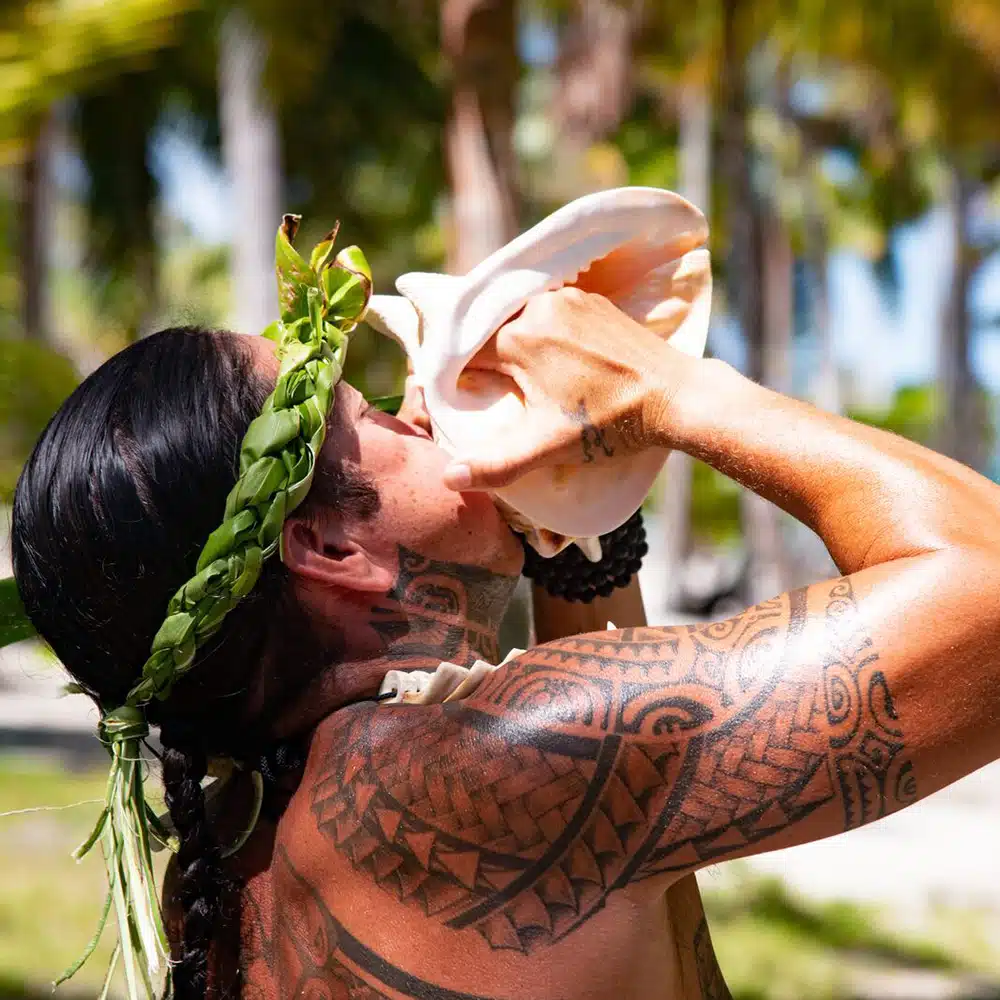
Man blowing a conch shell on Motu Mahana.

Manufacture of tapa, a vegetable fabric obtained by the beaten bark technique.

Traditional dance on a white sand beach facing the turquoise lagoon of Bora Bora.

Tatouages polynésiens et couronne végétale.
What would you like visitors to Polynesia to take away from their journey?
First and foremost, that they need to return! In my opinion, several journeys are needed to truly discover the diversity of each archipelago within the Polynesian Triangle. As a native lecturer-guide, my aim is to take visitors beyond folklore and into the heart of the culture. What travellers discover here often leads them to reflect on their own lives. Polynesia elevates spirituality — people often tell me there is a “before” and an “after” this journey.
Photo credits: ©StudioPONANT / J. Fabro, T. Garnier, E. Gontier ©PONANT / Tim Mckenna; Tahiarii Pariente; ©Roger Paperno

PONANT takes you there
Discover the cultures of the Pacific