

 Explore to inspire, a PONANT podcast
 PONANT's cruises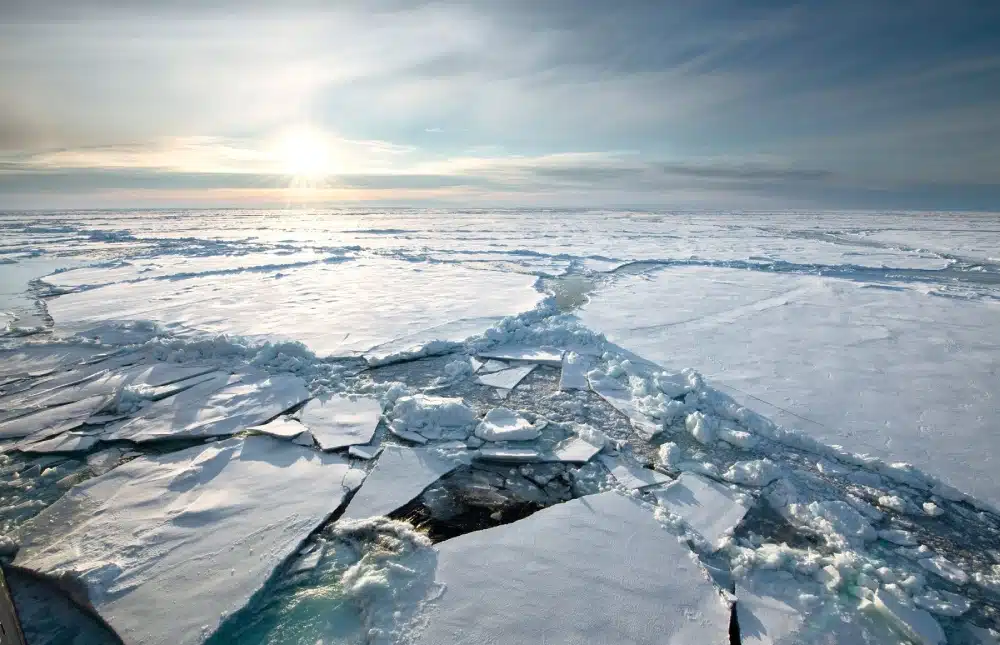
Interview with Daphné Buiron, glaciologist and naturalist guide
It is an object of fascination for explorers, shelters unexpected living creatures and regulates our climate. But what do we really know about the icy skin covering our polar oceans? Glaciologist and PONANT EXPLORATIONS naturalist guide Daphné Buiron shares the secrets of the pack ice with us and introduces us to a complex world that is bursting with far more life than we might imagine.
Key information:
- The pack ice, or “sea ice”, is made up of frozen seawater. It forms at temperatures of -1.8°C (28°F) or less, mainly in winter, and the majority melts in spring.
- It might last for a year or more and reach depths of six or seven metres.
- It isn’t as salty as seawater as it discharges a lot of its salt when it freezes.
- It is thicker and more centralised in the Arctic (as the ocean is ringed by land masses) and more seasonal in Antarctica.
- Fast ice is stable, whereas drift ice moves around.
- Icebergs are different from pack ice. They come from land-based glaciers and are made of freshwater.
- Pack ice is one of the foundations of the polar ecosystem and vital to reproduction, hunting and the entire food chain.
- It has a major role to play in regulating the climate because of its reflective qualities (in what is known as the albedo effect) and the way it feeds into global oceanic currents (also known as thermohaline circulation).
What exactly is “pack ice”?
Pack ice has an official name which explains precisely what it is: “sea ice”. It is literally frozen sections of the ocean which appear in winter as the cold takes hold. Saltwater doesn’t freeze at 0°C (32°F); temperatures have to get as low as -1.8°C (28°F). When they do, ice crystals form on the surface and gradually start to fuse together. Small crystals emerge first, which get bigger until they thicken to form a solid layer.
Can you see pack ice all year round?
Pack ice formation is a seasonal phenomenon. In spring, as the sun and warm air return, the pack ice starts to break up, melt and finally disappear until the following winter. This is why it’s known as annual pack ice. But in some sheltered areas of the High Arctic, such as north-east Greenland, sometimes the pack ice survives the summer and lasts for one or more years. This particularly solid perennial pack ice can be as thick as six to seven metres, with pressure ridges included. It records climate history, making it particularly important to protect.
Is pack ice salty?
When pack ice forms, the salt in seawater is mainly ejected via tiny fissures called brine drainage channels. As a result, pack ice is a lot less salty than its surrounding oceans.
What’s the difference between an iceberg and pack ice?

Icebergs stuck in the pack ice in Disko Bay, Greenland
While icebergs often get trapped in pack ice in winter, they aren’t made of seawater. Icebergs are formed on land, in that they are actually pieces of glacier (compacted snow turned into ice) which have come away and fallen into the sea. As such, icebergs are made of freshwater. Pack ice, on the other hand, is made in the sea, as it’s frozen ocean water. It generally starts to form in sheltered areas such as bays and fjords by attaching itself to the coastline before extending out to sea.
Visually, icebergs and pack ice are opposites. The latter is a thin layer of no more than a few metres, while an iceberg is a very hard, very much taller and thicker mountain of ice which might rise tens of metres above the surface and several hundreds of metres below.
How does pack ice spread out in the Arctic, as compared with the Antarctic?
The Arctic is surrounded by land and the pack ice is more centralised, thicker (averaging two to three metres, compared with one to two in Antarctica) and permanent at the North Pole. It grows in winter, spreading down into lower latitudes as far as northern Greenland, Spitsbergen and Canada’s Arctic islands.
The opposite is true in the Antarctic, which is an immense continent ringed by an ocean. The pack ice forms around it, but not as far because it quickly reaches warmer latitudes. In both cases, we can see it pulse with the seasons, as the ice stretches out during polar night, thickening from underneath, and shrinks in summer. These dynamic environments never stop moving.
Pack ice sometimes takes on extraordinary shapes…

Pancake ice in the Arctic
This landscape is always changing and the ice’s shape tells us how it formed. If the sea is rough when it freezes, little rings of ice crystals group together and collide with one another, so much so that their sharp edges might be worn smooth and curl upwards to make pancake ice (whose pieces will ultimately fuse together).
Alternatively, in sheltered spots, the surface will set all of a sudden, forming an immense smooth sheet which looks dark, elastic and something like a window. This is called nilas ice and it is very thin at just two or three centimetres. It undulates with the waves without ever breaking and it is impossible to walk on, but it is fascinating to see nonetheless.
Why isn’t the pack ice smooth?

A pressure ridge on the pack ice in Greenland
With the ocean moving beneath them, the pieces of ice are fused together to a greater or lesser degree, but they are always doing something. When two pieces collide, they form “pressure ridges”, or great blocks of ice that can rise several metres into the air. Their jagged surface makes the terrain extremely treacherous.
Conversely, when pieces move apart, dark channels of water open up. These fissures can be hidden under the snow, which is why guides always test the ice during expeditions to mark out a completely safe route.
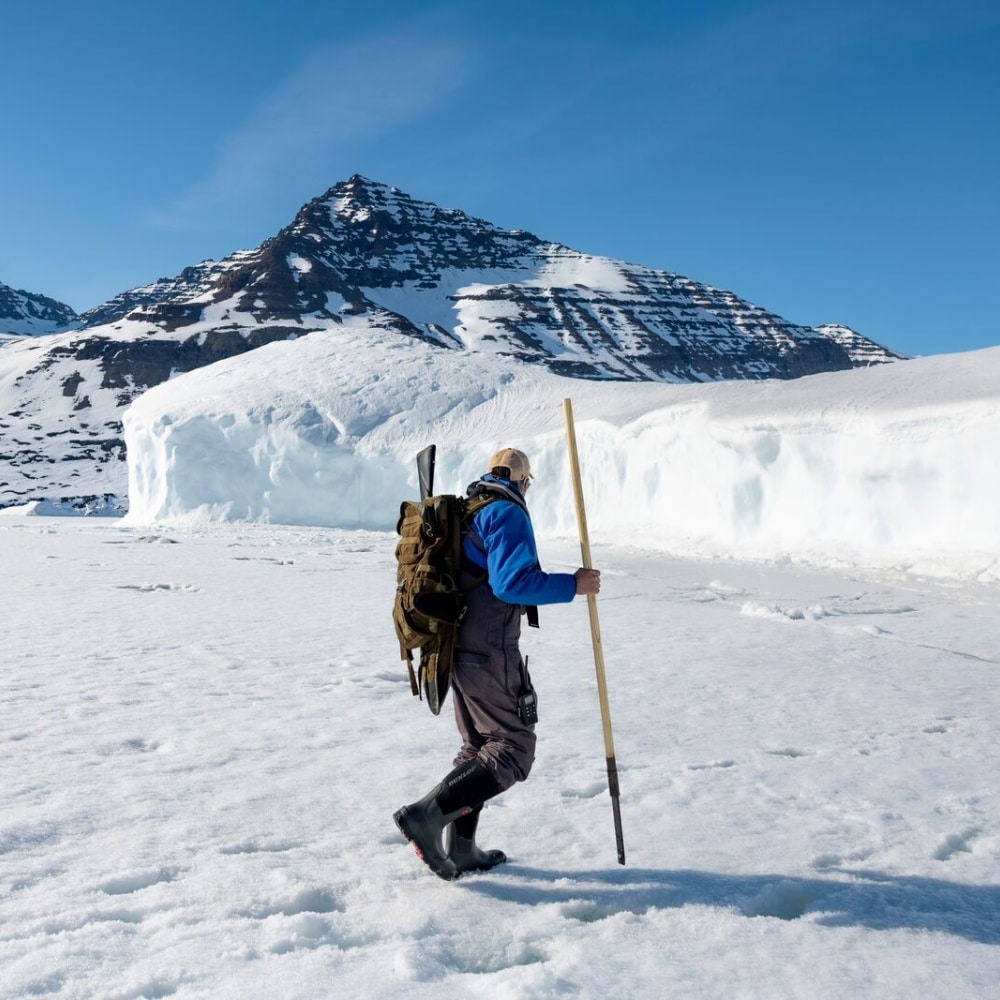
The tuuq: an essential tool in a guide’s kit
To test how solid the ice is, guides use a traditional Inuit tool known as a tuuq. These long sticks have a metal point at the end. When they strike the ice, the sound it makes and the way it withstands impact tells us how thick it is. Thirty centimetres of consistent ice is considered solid enough to hold a group of people, and lorries can drive across pieces measuring 60 centimetres or more. In late winter, annual pack ice might get as thick as two metres.
Ice can be described as “fast” or “drift”. What’s the difference?

Drift ice off Greenland
It all comes down to movement. Fast ice stays at the shore, stuck to rocks or islands. It’s stable and safe for wildlife in springtime. In fact, it’s here that seals birth their young and bears hunt. It’s also used by Inuit to get around on dog sleds and set up hunting camps.
However, once the ice comes away in the wind and starts floating off to sea, it becomes drift ice. It moves with the water currents, forming pieces of varying size. At this point, the ice has become unstable. If the pieces are huge, the visual difference between fast and drift ice is subtle, but when the latter starts to break up, the landscape is a lot more fractured.
A strange phenomenon called a polynya sometimes descends on these white landscapes. Can you tell us more about this?

A whale feeding in the water around the pack ice in Antarctica
Polynyas are hard to spot from the bridge of a ship because they’re so huge, but they are very visible via satellite. They are a vast zone of water in the middle of the pack ice which never freezes, even in extremely cold temperatures, because of constant winds or water currents. Paradoxically, this is where most sea ice is “made”, because it’s always forming then being pushed out by the wind.
Polynyas are vital for the ecosystem, in that the unfrozen water offers crucial breathing space. Sea mammals such as whales, narwhals and seals can come take some air and find food in the depths of winter without ice getting in the way.
Another life force is concealed under the ice’s surface. What is phytoplankton bloom?
The pack ice isn’t sterile and it has a crucial role to play as the basis for the entire polar food chain. In winter, during polar night, microalgae and bacteria shelter in cracks in the ice. In spring, sunlight shines on the now-thinner pack ice and the bloom takes place. Phytoplankton bursts into life below surface to form vast underwater meadows. These are the basis for the entire polar food chain. The algae nourish the krill, which nourish the fish, birds, penguins, seals and whales. Without the pack ice to protect the phytoplankton, the entire ecosystem would collapse.
How does the wildlife use the pack ice physically, in addition to finding food?

A polar bear hunting on the pack ice in Greenland
Pack ice is an essential environment for polar wildlife. Its first purpose is reproduction. Seals birth their young on the fast ice in spring, as their babies can’t swim. The pack ice also provides seals with a dry place to sleep and shelter from ocean predators such as orcas after long periods of a week or more out fishing.
It’s also an enormous hunting ground for Arctic polar bears, which cover hundreds of miles to find food. In Antarctica, penguins use the pack ice as a corridor to the ocean. It’s vital for emperor penguins in particular, as they breed and rear their young there and use it as a refuge when they aren’t fishing.

An inhabited land
In the Arctic, the pack ice isn’t a barrier but an extension of the land for Inuit and Greenlandic communities, and they use it for both hunting and communicating with other villages. The fast ice also serves as something of a sea wall, protecting the land from the waves and storms. As the ice shrinks, coastal erosion is happening at ever-greater speeds, threatening people’s homes.
What role does pack ice have to play in maintaining our current global climate?
The pack ice is vital. First, its white surface acts as a mirror, reflecting solar energy back into space in what is called the albedo effect and keeping the planet cool. If the ice melts, the dark ocean absorbs the sun’s heat, accelerating warming to create a sort of thermal vicious circle.
The pack ice is also a driving force for the world’s oceans. When it freezes, ice expels salt, making the water denser and heavier. That water sinks to the ocean floor, forming a deep current that creates movement and pulls warmer water to the surface. This thermohaline circulation is the basis of the Atlantic Gulf Stream, among other phenomena. As the pack ice disappears, this driving force weakens, which in turn directly impacts on the global climate.
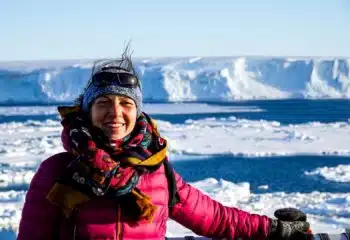
Daphné Buiron
For her doctorate in climatology and glaciology, geoscientist Daphné Buiron studied ice cores to get a better understanding of the Earth’s climate. In 2012, she spent the winter on the Dumont d’Urville base in Adélie Land (Antarctica) and has been exploring polar regions as an expedition guide, speaker and research coordinator ever since. She cares deeply about the Arctic and Inuit culture, and she shares her experiences in her writing, photography and educational workshops.
Photo credits: PONANT/Julien Fabro; Benjamin Hardman; StudioPONANT/Morgane Monneret; Nathalie Michel; Olivier Blaud

Let PONANT take you there
Navigate the ice